Annual Waste Transfer Note — What People Are Actually Looking For
If you've been searching for an "annual waste transfer note" or "annual WTN", you've found what you're after — it's just called something different in the regulations.
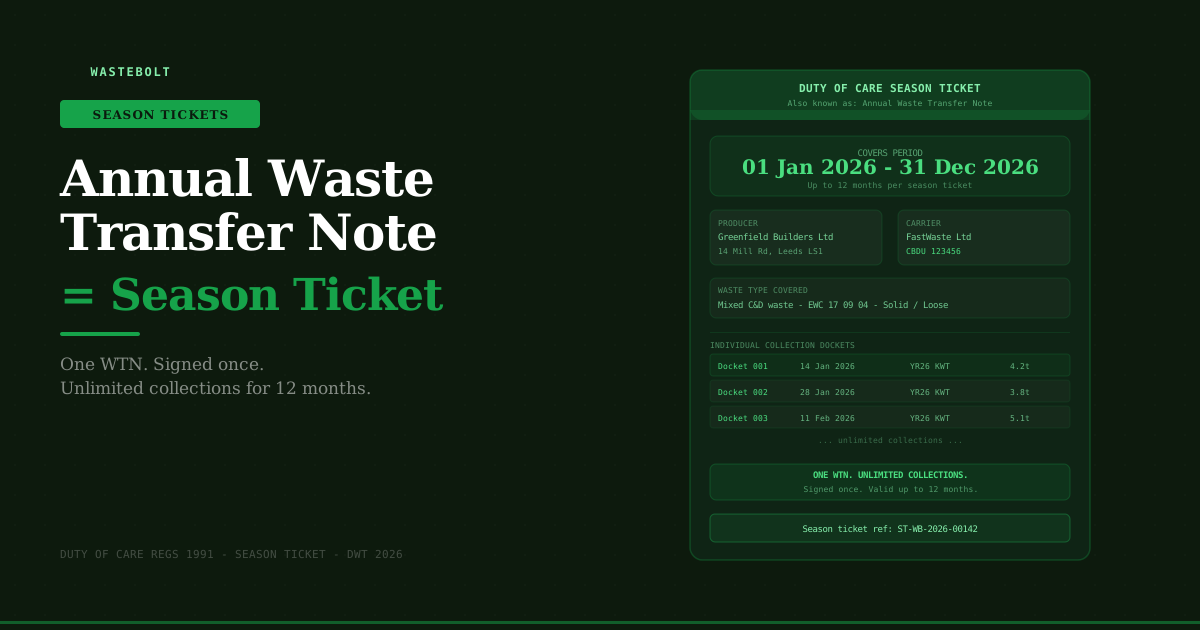
The official name is a Duty of Care Season Ticket. It does exactly what an annual waste transfer note would do: it covers a series of repeated waste transfers between the same producer and the same carrier, for the same waste type, over a period of up to 12 months. One document. Signed once. Valid for the entire period.
This page explains how season tickets work, when you should use one instead of individual WTNs, and how to set one up.
What Is a Duty of Care Season Ticket?
A Duty of Care Season Ticket is a special type of waste transfer arrangement that allows the same waste to move between the same two parties repeatedly, without needing a new WTN for every single collection.
The legal basis is the same as a standard WTN — Section 34 of the Environmental Protection Act 1990 and the Duty of Care Regulations 1991. The season ticket satisfies the duty of care documentation requirement for all collections it covers.
The key requirements are:
- The same waste type must be transferred on every collection (same EWC code, same description)
- The same producer (or waste holder) must be transferring the waste
- The same carrier must be collecting it
- The ticket must be signed by all three parties (producer, carrier, consignee) at the outset
- It can cover a period of up to 12 months — not necessarily a calendar year
- Each individual collection must still be recorded on a docket (date, vehicle, weight)
Season Ticket vs Individual WTN — When to Use Which
Use a season ticket when:
- The same carrier collects the same type of waste from you regularly (weekly, fortnightly, monthly)
- You have an ongoing construction contract with the same waste removal company
- You're a skip hire company with regular commercial customers on repeat collections
- A manufacturer has daily or weekly collections of the same process waste
- A retailer has weekly cardboard or packaging collections by the same contractor
Use individual WTNs when:
- It's a one-off collection
- The waste type varies between collections
- The carrier changes
- The receiving site changes
- You're not sure how many collections there will be
The practical test is simple: if you're writing the same WTN out week after week for the same customer, carrier, and waste type — you should have a season ticket.
What a Season Ticket Must Include
A season ticket contains all the same information as a standard WTN, plus a defined validity period. It must include:
Producer / Holder details (Part A)
- Business name and address
- SIC code
- Any relevant permit or exemption number
Carrier details (Part B)
- Carrier name and address
- Waste Carrier Registration number (CBDU or CBDL for England/Wales, ROC UT/LT for Northern Ireland, WCR for Scotland)
- This must be verified as current before the season ticket is agreed
Consignee / Receiving site (Part C)
- Receiving site name and address
- Environmental permit number or registered exemption
Waste description (Part D)
- Specific waste description — the same waste type that will be collected on every trip
- EWC code
- Physical form and containment method
- Recovery or disposal code
Validity period (Part E)
- Start date and end date — maximum 12 months
- Note that this does not have to be a calendar year. A season ticket starting 1 April 2026 would run to 31 March 2027 at the latest.
Signatures
- All three parties sign the season ticket once at the outset
- No further signatures are required on the season ticket itself for subsequent collections
The Docket Requirement — What Happens on Each Collection
This is the part most people miss. A season ticket removes the need for a new WTN on each collection — but you still need a docket for every individual lift.
A docket is a simpler document that records the specific details of that particular collection:
- Date and time of collection
- Vehicle registration
- Weight or quantity of waste collected
- Reference to the season ticket it relates to
The docket is not a WTN. It doesn't need all five parts and all three signatures. But it must exist for every collection made under the season ticket, and both the carrier and producer should retain copies.
Think of the season ticket as the framework agreement and the docket as the record of each individual transaction under that agreement.
How Long Is a Season Ticket Valid?
A season ticket can cover a period of up to 12 months. It does not have to run from January to December — it can start and end on any dates, as long as the total period is 12 months or less.
Once the season ticket expires, you need to create a new one if the arrangement is continuing. You cannot backdate a season ticket or extend it beyond 12 months.
Retention period: Season tickets must be kept for a minimum of 2 years in England, Wales and Northern Ireland, and 3 years in Scotland — the same as standard WTNs.
Can a Season Ticket Cover Hazardous Waste?
No. Season tickets are only available for non-hazardous controlled waste.
Hazardous waste requires an individual Hazardous Waste Consignment Note for every transfer — there is no season ticket equivalent for hazardous material. Each hazardous movement must be individually documented, signed, and tracked.
If you're regularly moving hazardous waste such as waste oil, batteries, or contaminated materials, each collection needs its own consignment note.
Does a Season Ticket Work for DWT 2026?
Yes — season tickets will continue to be valid as a documentation method after the Digital Waste Tracking mandate comes into force in October 2026.
However, each collection made under a season ticket will still need to be reported to the EA's DWT platform at the point of receipt by the receiving site. The season ticket covers the WTN documentation requirement, but DWT submission is a separate obligation for the receiving site.
In Wastebolt, season tickets and their associated dockets are stored digitally. When a docket is created under a season ticket, the relevant movement data is available for DWT submission automatically.
Setting Up a Season Ticket in Wastebolt
In Wastebolt, season tickets are created under /season-tickets/create. You fill in all the same fields as a standard WTN, set the validity period, and send a signing link to all three parties. Once signed, the season ticket is stored in the cloud and linked to all subsequent dockets raised under it.
Drivers completing collections under a season ticket can reference the ticket number on their docket. The system tracks how many collections have been made and when the ticket expires.
Frequently Asked Questions
Is an annual waste transfer note the same as a season ticket? Yes — the official term under the Duty of Care Regulations is "season ticket." The concept of an annual WTN is exactly what a season ticket provides: one document covering a year of repeated collections.
Can I use one season ticket for multiple waste types? No. A season ticket covers a single waste type — same EWC code, same description, same containment method. If you have multiple waste streams collected by the same carrier, you need a separate season ticket for each waste type.
What happens if the carrier changes mid-season ticket? If the carrier changes, the season ticket is no longer valid for collections by the new carrier. You'll need a new season ticket (or individual WTNs) for the replacement carrier, even if the waste type and producer remain the same.
Does a season ticket need to be renewed every year? Yes. Once a season ticket expires it cannot be extended. You create a new one for the next period. In Wastebolt, the system alerts you before a season ticket expires so you can renew in advance.
What if the waste quantity varies between collections? That's fine — the season ticket covers a waste type, not a fixed quantity. Each docket records the actual weight for that collection. The season ticket doesn't need to specify a fixed quantity per collection.
Can I have a season ticket with multiple receiving sites? No. A season ticket covers a specific route: one producer, one carrier, one consignee. If the same producer uses the same carrier to send waste to two different sites, that's two season tickets.
Last updated: May 2026. Legal basis: Environmental Protection Act 1990 · Duty of Care Regulations 1991.