Introduction
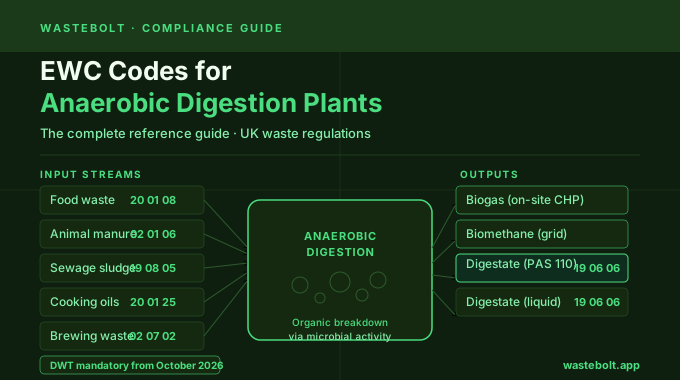
Anaerobic digestion (AD) plants accept a wide variety of organic waste streams and produce digestate and biogas as outputs. Every waste transfer into or out of an AD plant requires a legally compliant Waste Transfer Note (WTN) or, for hazardous streams, a Hazardous Waste Consignment Note — each referencing the correct six-digit European Waste Catalogue (EWC) code.
Getting the EWC code wrong is the most common compliance mistake made on waste transfer documentation. This guide covers every major input and output stream handled by UK anaerobic digestion facilities, the correct EWC code for each, and what documentation each transfer requires.
Tip: Not sure which EWC code applies to a specific waste stream? Use our free EWC Code List & Search Tool to search the full UK Waste Classification system by keyword or code.
What is an EWC Code?
An EWC code is a six-digit code from the European Waste Catalogue (retained in UK law post-Brexit as the UK Waste Classification System). Every waste transfer note completed in the UK must include the correct EWC code for the waste being moved.
The six digits are structured as three pairs:
- First pair — the industry or process generating the waste (e.g. 02 = agriculture, food and beverage)
- Second pair — the sub-category within that industry
- Third pair — the specific waste type
Codes marked with an asterisk (*) in the official catalogue are hazardous and require a Hazardous Waste Consignment Note rather than a standard WTN.
Input Waste Streams — EWC Codes
Food and Kitchen Waste
| Waste Description | EWC Code | Notes |
|---|---|---|
| Biodegradable kitchen and canteen waste | 20 01 08 | Most common food waste code for AD plants — restaurants, takeaways, canteens |
| Food and beverage waste from food production | 02 07 04 | Waste from alcoholic beverage production |
| Waste from fruit, vegetable, cereal processing | 02 03 04 | Fruit and vegetable processing facilities |
| Off-specification food products | 02 03 04 | Surplus or rejected food products suitable for AD |
| Animal-based food waste from processing | 02 02 03 | Meat and fish processing — check for ABP regulations |
| Mixed municipal waste containing organics | 20 03 01 | Only where source separation has not occurred |
Important note for food waste: Any food waste of animal origin (meat, fish, dairy) is also classified as an Animal By-Product (ABP) under EU Regulation 1069/2009 (retained in UK law). AD plants accepting ABP-category food waste must hold the appropriate APHA approval in addition to their environmental permit.
Agricultural and Manure Streams
| Waste Description | EWC Code | Notes |
|---|---|---|
| Animal manure | 02 01 06 | Slurry, farmyard manure — most common agricultural input to AD |
| Waste from animal tissue | 02 01 02 | Animal tissue waste not classified as ABP category 1 |
| Crop and harvest waste | 02 01 03 | Plant tissue waste from agricultural operations |
| Mixed agricultural waste | 02 01 99 | Agricultural wastes not otherwise specified |
| Silage effluent | 02 01 06 | Classed alongside manure for AD purposes |
Note: Manure transfers between farms and AD plants require a WTN. Where the manure is being applied to land as a fertiliser (not transferred to an AD plant), different rules apply under the Nitrates Regulations.
Sewage Sludge and Water Industry Streams
| Waste Description | EWC Code | Notes |
|---|---|---|
| Sewage sludge | 19 08 05 | The primary water industry input to AD — from wastewater treatment |
| Grease trap waste | 19 08 09 | Non-hazardous — from food industry interceptors |
| Grease trap waste (with solvents) | 19 08 10* | Hazardous — requires consignment note |
| Screenings from wastewater treatment | 19 08 01 | Solid waste removed at screening stage |
| Sludge from biological treatment | 19 08 12 | Non-hazardous biological sludge |
Note on sewage sludge: Sewage sludge destined for land application after digestion is regulated under the Sludge (Use in Agriculture) Regulations 1989 and requires additional record-keeping beyond the WTN.
Industrial and Commercial Organic Streams
| Waste Description | EWC Code | Notes |
|---|---|---|
| Fats, grease and oils from food processing | 02 05 02 | Dairy industry — non-hazardous |
| Waste from brewing and distilling | 02 07 02 | Spent grain, yeast, process liquors |
| Spent grain from brewing | 02 07 02 | Highly suitable for AD — high organic content |
| Glycerol waste from biodiesel production | 07 06 09 | Co-digestion feedstock |
| Organic waste from fruit/vegetable processing | 02 03 99 | Catch-all for processing wastes not otherwise specified |
| Paper and cardboard (organic fraction) | 20 01 01 | Only the organic fraction where used as co-feedstock |
Waste Oils and Fats (Co-digestion)
| Waste Description | EWC Code | Notes |
|---|---|---|
| Vegetable oils and fats | 20 01 25 | Cooking oils from restaurants and food producers |
| Edible oil waste from food preparation | 02 05 02 | Dairy and food processing |
| Mineral oils (non-hazardous) | 13 02 08 | Uncommon in AD — check permit conditions |
| Mineral oils (hazardous) | 13 01 10* | Hazardous — not suitable for standard AD |
Output Streams — EWC Codes
Digestate
Digestate is the material remaining after the anaerobic digestion process. It is typically high in nutrients and used as a biofertiliser. The EWC code depends on the inputs used.
| Digestate Type | EWC Code | Notes |
|---|---|---|
| Digestate from food waste inputs | 19 06 06 | Anaerobic digestion of non-hazardous waste — most common |
| Digestate from agricultural inputs only | 02 01 06 | Where the AD plant processes only manure/slurry — treated as agricultural waste |
| Digestate from mixed inputs | 19 06 06 | Default code where mixed waste streams are co-digested |
| Liquid digestate fraction | 19 06 06 | Separated liquid fraction after dewatering |
| Solid digestate fraction | 19 06 06 | Separated solid fraction — sometimes referred to as fibre |
Important: Digestate that meets the PAS 110 quality protocol is classified as a recovered material (not waste) and does not require a WTN for land application. However, digestate that does not meet PAS 110 remains classified as waste and all transfers require full documentation.
Biogas and Biomethane
Biogas produced on-site and combusted in a CHP unit is not transferred as waste and does not require a WTN. Where biogas is transferred off-site or injected into the gas grid as biomethane, it is no longer classified as waste.
However, any waste gas streams or condensate from biogas processing may require documentation:
| Waste Description | EWC Code | Notes |
|---|---|---|
| Waste from biogas desulphurisation | 19 06 05 | Liquors from biogas cleaning |
| Spent activated carbon from biogas upgrading | 19 01 10* | Hazardous — check with your permit holder |
Documentation Requirements by Transfer Type
| Transfer Type | Document Required | Retention Period |
|---|---|---|
| Food waste input to AD plant | Waste Transfer Note | 2 years (3 in Scotland) |
| Agricultural manure to AD plant | Waste Transfer Note | 2 years (3 in Scotland) |
| Sewage sludge to AD plant | Waste Transfer Note | 2 years (3 in Scotland) |
| Hazardous waste (asterisked codes) | Hazardous Waste Consignment Note | 3 years |
| Digestate to land (PAS 110 compliant) | No WTN required — material not waste | Keep PAS 110 records |
| Digestate to land (non-PAS 110) | Waste Transfer Note | 2 years (3 in Scotland) |
| Digestate to another facility | Waste Transfer Note | 2 years (3 in Scotland) |
Common EWC Code Mistakes at AD Plants
Using 20 03 01 (mixed municipal waste) for source-segregated food waste. Source-segregated food waste should be coded 20 01 08. Using the mixed waste code suggests inadequate source separation and can cause issues with permit compliance.
Not differentiating between sewage sludge codes. Sewage sludge (19 08 05) and biological sludge (19 08 12) are different waste streams — confirm which applies with the producing site.
Applying food waste codes to ABP-regulated material. Where food waste contains meat, fish, or dairy, additional ABP documentation is required alongside the WTN. The EWC code alone does not capture this regulatory requirement.
Using agricultural codes for commercial food waste. 02 01 06 (animal manure) is specific to agricultural sources. Commercial food waste from restaurants and food producers is 20 01 08 regardless of whether it is processed through the same AD plant.
Assuming digestate is always waste-free. Digestate is only a recovered material (and therefore exempt from WTN requirements) where it meets PAS 110. Non-compliant digestate remains a waste at all times.
Carrier Licence Requirements
Any company physically transporting waste to or from an AD plant must hold a valid Waste Carrier Licence issued by the relevant environmental regulator:
- England: Environment Agency — check the public register
- Scotland: SEPA
- Wales: Natural Resources Wales
- Northern Ireland: NIEA
Always verify the carrier registration number before waste leaves your site. An expired or invalid registration leaves the producing site legally liable even where the carrier was paid to transport the waste.
Digital Waste Tracking and AD Plants
From October 2026, Digital Waste Tracking (DWT) becomes mandatory across the UK. All waste movements — including transfers to and from AD plants — will need to be recorded digitally on the EA's central DWT platform rather than on paper WTNs.
AD plants processing large volumes of material across multiple waste streams will need a system capable of handling multiple EWC codes, varied carrier details, and digestate output documentation simultaneously.
Wastebolt connects directly to the EA's DWT platform and supports all waste streams covered in this guide. Start a free trial to see how it handles AD plant compliance documentation.
Frequently Asked Questions
Does every load of food waste into an AD plant need its own WTN? Yes, unless a Season Ticket is in place. A Season Ticket covers multiple transfers of the same waste type between the same producer and the same AD plant over up to 12 months — and significantly reduces paperwork for regular collections.
Can I use one WTN for multiple EWC codes in the same load? A single WTN can cover mixed waste where the load genuinely contains multiple waste types. Each EWC code should be listed separately in Section D. Where the waste streams have significantly different characteristics, separate WTNs are cleaner from a compliance perspective.
Does digestate that meets PAS 110 need any documentation at all? PAS 110-compliant digestate is a recovered material and does not require a WTN. However, the AD plant must maintain records demonstrating PAS 110 compliance, and the receiving farm must keep application records under the Nitrates Regulations.
What happens if we use the wrong EWC code? The Environment Agency can issue a fixed penalty or refer the matter for prosecution. More practically, incorrect EWC codes on waste records indicate non-compliance during an audit and can trigger further investigation of the facility's permit conditions.
Are biogas plant inputs covered by the same EWC codes? Yes — biogas plants and AD plants use the same EWC coding system. The process differs but the waste classification system is identical.
Summary — Quick Reference EWC Code Table
| Waste Stream | EWC Code | Hazardous? |
|---|---|---|
| Food and kitchen waste (restaurants, canteens) | 20 01 08 | No |
| Animal manure and slurry | 02 01 06 | No |
| Sewage sludge | 19 08 05 | No |
| Grease trap waste | 19 08 09 | No |
| Grease trap waste (with solvents) | 19 08 10 | Yes* |
| Fruit and vegetable processing waste | 02 03 04 | No |
| Brewing and distilling waste | 02 07 02 | No |
| Vegetable oils and cooking fats | 20 01 25 | No |
| Digestate (from non-hazardous inputs) | 19 06 06 | No |
| Spent activated carbon from biogas upgrading | 19 01 10 | Yes* |
*Hazardous streams require a Hazardous Waste Consignment Note — not a standard WTN.
Last updated: April 2026. For the most current EWC code classifications, refer to the UK Waste Classification Technical Guidance (WM3).