Do Farms Need Waste Transfer Notes?
This is the question most farmers start with — and the answer is: sometimes yes, sometimes no, and understanding the difference is where most compliance problems begin.
Farm waste sits in a genuinely unusual position in UK waste law. Many materials produced on a farm — slurry, manure, crop residues — are not legally classified as "waste" at all when managed in certain ways on the farm itself. But the moment those same materials cross a farm boundary, get sent to an AD plant, or are handled by a third-party contractor, they can become controlled waste requiring proper documentation.
This guide covers every significant waste stream an agricultural business generates, the correct EWC code for each, and — critically — when you are and are not required to produce a Waste Transfer Note.
Tip: Not sure which EWC code applies to a specific waste stream? Use our free EWC Code List & Search Tool to search the full UK Waste Classification system by keyword or code.
The Agricultural Exemption System — What It Means in Practice
Before looking at specific EWC codes, it's essential to understand the agricultural exemptions framework because it determines whether a material is "waste" at all.
Manure and Slurry on Your Own Land
Manure, slurry, and other organic materials applied to agricultural land as fertiliser are not classified as waste provided they are:
- Produced on the farm where they are being applied, or obtained from another farm
- Applied at agronomically appropriate rates
- Not causing environmental harm
- Managed in line with the Nitrates Regulations where applicable
This means: if you spread your own slurry on your own fields, you do not need a WTN. The material is not waste — it is a by-product being used as a soil improver.
When Manure Becomes Controlled Waste
The same manure that is not waste when spread on your fields becomes controlled waste — and requires a Waste Transfer Note — when:
- It is collected and removed from the farm by a third-party contractor
- It is sent to an anaerobic digestion plant for energy recovery
- It is transferred to another farm or land holding that is not part of your agricultural unit
- It is stored in a way or quantity that takes it outside normal agricultural management
This boundary — the point at which agricultural by-product becomes controlled waste — is the most common source of compliance confusion on farms and the most common finding during EA farm inspections.
The T Exemptions
Certain waste management activities on farms are covered by registered exemptions rather than full environmental permits. The most relevant for typical farm operations are:
T23 — Aerobic composting and associated prior treatment Allows the composting of specified biodegradable materials on a farm, including plant tissue waste and food processing residues, within defined quantity limits.
U2 — Use of waste to manufacture finished goods Covers some on-farm use of waste materials that would otherwise require a permit.
These exemptions must be registered with the Environment Agency (or relevant regulator) before the activity begins. Operating under an unregistered exemption is a compliance offence.
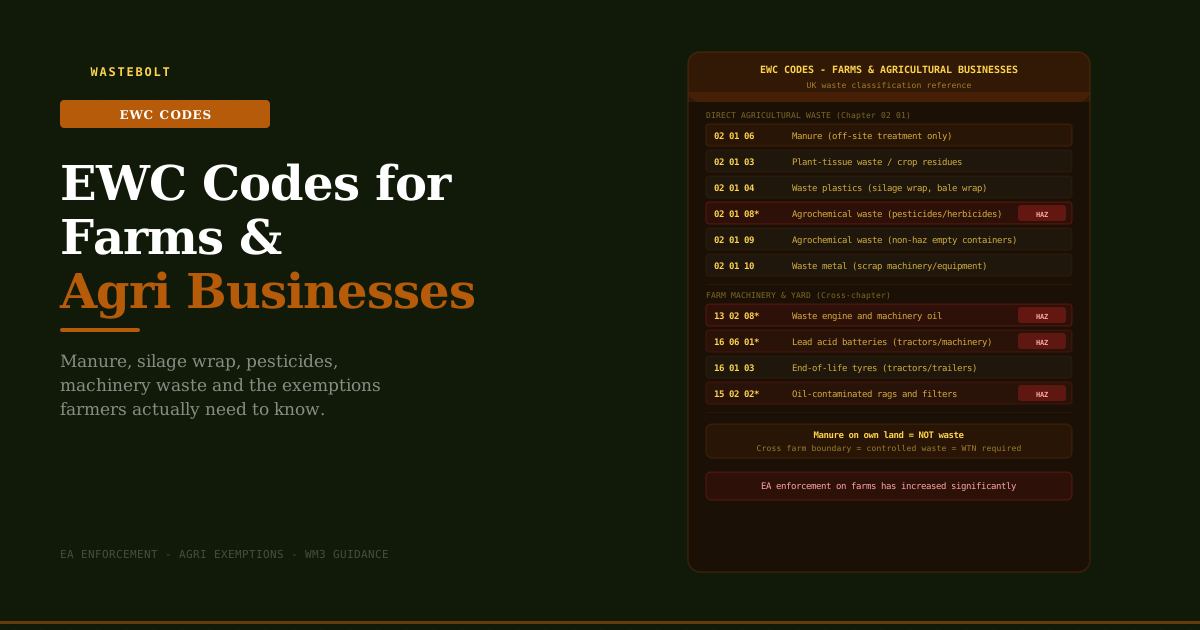
Chapter 02 01 — Agricultural Waste EWC Codes
Most agricultural waste falls under Chapter 02 of the EWC catalogue, specifically sub-chapter 02 01 (wastes from agriculture, horticulture, aquaculture, forestry, hunting and fishing).
02 01 06 — Animal Faeces, Urine and Manure
Full description: Animal faeces, urine and manure (including spoiled straw), effluent, collected separately and treated off-site
Hazardous: No
This is the correct EWC code when manure or slurry is being moved off-farm — to an AD plant, a spreading contractor taking it to different land, or a composting facility.
The phrase "collected separately and treated off-site" is key: this code applies when the material is leaving the farm for treatment or processing elsewhere. Manure spread on the farm's own land under normal agricultural management does not need this code because it is not classified as waste.
Common uses of 02 01 06:
- Farmer sending slurry to a neighbouring AD plant
- Contractor collecting manure for spreading on land outside the farm unit
- Spoiled silage or contaminated bedding removed for composting off-site
Documentation: Standard Waste Transfer Note required when the material is collected and moved off-site. If the same contractor collects from the same farm to the same destination regularly — a common arrangement with AD plants — a Season Ticket covering up to 12 months avoids the need for a new WTN every time.
02 01 03 — Plant-Tissue Waste
Hazardous: No
Crop residues, harvest waste, rejected or surplus produce, green waste from horticultural operations, and vegetable processing residues from farm-level grading and packing all fall under 02 01 03.
Examples:
- Potato haulm and rejected potatoes from grading
- Vegetable tops and trimmings from on-farm packing lines
- Surplus or rejected fruit
- Straw and crop residues where these are removed rather than incorporated
- Green waste from orchard and hedgerow management
When is this waste? Plant tissue on the farm used as animal feed, incorporated into soil under good agricultural practice, or composted under a registered exemption is generally not waste. Plant tissue removed from the farm, taken to a composting facility, or collected by a contractor for processing is controlled waste.
Documentation: Standard Waste Transfer Note when moving off-farm.
02 01 04 — Waste Plastics
Hazardous: No
Agricultural plastic waste is one of the highest-volume non-hazardous waste streams on UK farms. 02 01 04 covers:
- Silage wrap and bale wrap (by far the largest volume)
- Polytunnel and fleece film
- Irrigation pipe and fittings
- Seedbed covers and mulch films
- Fertiliser and seed bags
- Chemical containers (where these have been rinsed and are not contaminated)
The silage wrap problem: The UK generates an estimated 100,000 tonnes of agricultural film annually. Silage wrap in particular accumulates rapidly on farms. It cannot go to landfill without treatment and most local authority recycling centres will not accept it from commercial agricultural premises.
Specialist agricultural plastic recycling schemes exist — most operate on a collected basis, with contractors visiting farms. Each collection requires a WTN. Where the same contractor collects regularly, a Season Ticket is appropriate.
Note on contaminated containers: Chemical containers that have held pesticides or fertilisers and have not been adequately triple-rinsed may not be classified as 02 01 04 — see 02 01 08* and 02 01 09 below.
Documentation: Standard Waste Transfer Note. Ensure the receiving facility is authorised to accept agricultural plastics — not all plastics recyclers are.
02 01 08* — Agrochemical Waste Containing Hazardous Substances
Hazardous: Yes
This code covers agricultural chemicals and their residues that are classified as hazardous — primarily:
- Pesticide and herbicide waste and residues that are hazardous
- Partially used or out-of-date pesticide products
- Pesticide containers that have not been adequately cleaned and still contain product residues
- Fungicide, insecticide, and rodenticide waste classified as hazardous
- Contaminated material (soil, absorbents, PPE) from pesticide spills
Hazardous: Yes — agrochemical waste at this classification exhibits HP 6 (acute toxicity) and often HP 14 (ecotoxic) properties.
Documentation: Hazardous Waste Consignment Note required. The carrier must hold an Upper Tier waste carrier registration. Only specialist hazardous waste contractors should be used.
Practical note: The FACTS and BASIS-registered agronomist who advises on pesticide use should also be able to advise on correct disposal routes for surplus or out-of-date products. Many agrochemical suppliers operate take-back schemes for unused product.
02 01 09 — Agrochemical Waste Other Than Those Mentioned in 02 01 08
Hazardous: No
This covers agrochemical waste that is not classified as hazardous. Most commonly:
- Thoroughly triple-rinsed pesticide and herbicide containers where residue levels are below hazardous thresholds
- Empty fertiliser bags and sacks
- Non-hazardous agricultural chemical packaging
The triple-rinse rule: An empty pesticide container that has been properly triple-rinsed (or pressure-rinsed) typically qualifies as 02 01 09. A container that has not been rinsed or still visibly contains product residue is 02 01 08*.
The NFU and AHDB both publish guidance on correct pesticide container rinsing and disposal. Following this guidance demonstrates due diligence if classification is questioned.
Documentation: Standard Waste Transfer Note for 02 01 09.
02 01 10 — Waste Metal
Hazardous: No
Scrap metal from agricultural equipment — worn machinery parts, redundant equipment, obsolete irrigation systems, fencing wire — is classified as 02 01 10.
This is distinct from general scrap metal codes (17 04 xx) which are more commonly used in construction contexts. 02 01 10 specifically reflects the agricultural origin of the material.
Documentation: Standard Waste Transfer Note. The scrap metal dealer or collector must hold a Scrap Metal Dealer licence as well as a waste carrier registration.
Note on machinery containing fluids: Agricultural machinery being scrapped that still contains hydraulic fluid, engine oil, or other fluids needs those fluids drained and separately classified before the scrap metal is collected. The drained fluids are waste oil (13 02 08*) and require a consignment note.
02 01 99 — Wastes Not Otherwise Specified
Hazardous: No
The catch-all for agricultural waste that does not fit any more specific code within Chapter 02 01. Use this only where no other code is appropriate — it is better practice to identify the specific code where one exists.
Cross-Chapter Codes — Farm Machinery and Yard
Farms generate significant volumes of waste from machinery maintenance, vehicle operations, and yard activities that are classified under chapters other than 02 01.
13 02 08* — Waste Engine and Machinery Oil
Hazardous: Yes
All farms with tractors, combines, and other powered machinery generate waste oil from oil changes, hydraulic system maintenance, and machinery repairs. Waste mineral oil is hazardous (HP 5, HP 14) regardless of quantity.
This is one of the most commonly mishandled hazardous waste streams on farms. Waste oil must not be burned in open fires, poured onto land, or disposed of in general farm waste. It must be collected by a licensed hazardous waste contractor.
Documentation: Hazardous Waste Consignment Note required. Many agricultural merchants and oil suppliers offer a waste oil collection service — always ensure a consignment note is provided for every collection.
16 06 01* — Lead Acid Batteries
Hazardous: Yes
Tractor batteries, machinery batteries, and ATV batteries are all lead-acid and hazardous. They must not go in farm scrap skips or general waste.
Battery recycling contractors typically collect for free given the lead recovery value. Always obtain a consignment note.
16 01 03 — End-of-Life Tyres
Hazardous: No
Tractor tyres, trailer tyres, and telehandler tyres. These are non-hazardous but cannot go to landfill without treatment and require a specialist tyre recycling contractor.
Farms with large volumes of tyres (particularly those used as silage clamp weights) face an additional consideration: the EA has previously issued guidance on the use of tyres as clamp weights. Check current EA guidance on this use.
Documentation: Standard Waste Transfer Note.
15 02 02* — Oil-Contaminated Rags, Filters and Absorbents
Hazardous: Yes
Oily rags from machinery maintenance, used oil filters from tractors and equipment, and absorbent materials used to soak up oil spills in the yard are all hazardous.
These are commonly disposed of incorrectly — thrown in farm skips or burned — on farms. Both routes are illegal and both have been subject to EA enforcement.
Documentation: Hazardous Waste Consignment Note required.
15 01 01 / 15 01 02 — Packaging Waste
Hazardous: No
Paper and cardboard packaging (15 01 01) and plastic packaging (15 01 02) from inputs — feed bags, fertiliser sacks, seed bags, chemical packaging — are non-hazardous provided they are not contaminated with hazardous product residues.
Documentation: Standard Waste Transfer Note. Where the same contractor collects regularly, a Season Ticket is appropriate.
Animal By-Products — A Separate Framework
Dead livestock and certain other animal-derived materials from farms are not regulated under the waste framework at all — they fall under the Animal By-Products Regulations (ABPR) 2011, which has its own documentation and disposal system.
Category 1 ABP (highest risk — including specified risk material and fallen stock from certain species) must be collected by an approved Category 1 ABP contractor and incinerated or processed at an approved facility.
Category 2 ABP (including fallen stock from other species, manure in certain circumstances) — collected by approved contractors, disposed of at approved facilities.
Category 3 ABP (lower risk — food waste, former foodstuffs) — can be used in animal feed or processed at approved composting/biogas facilities.
Key point: fallen stock requires ABP documentation, not a waste transfer note. Using a waste carrier to collect and dispose of dead livestock is not legally acceptable — only approved ABP contractors can handle Category 1 and 2 material.
The EWC code 02 01 02 (animal-tissue waste) exists within the waste classification system but in practice most animal-tissue waste from farms is handled through the ABP framework rather than the waste framework. If you are in any doubt about which framework applies to a specific material, contact the APHA (Animal and Plant Health Agency).
Digestate from On-Farm AD Plants
If your farm operates an on-site anaerobic digestion plant, the outputs have their own EWC codes:
- 19 06 06 — Digestate from anaerobic treatment of animal and vegetable waste
- 19 06 05 — Liquor from anaerobic treatment of animal and vegetable waste
Digestate that meets the PAS 110 quality protocol is classified as a recovered material, not waste, and does not require a WTN for land application. Digestate that does not meet PAS 110 remains classified as waste and requires WTN documentation for all transfers.
EWC Code Quick Reference for Farms
| Waste Type | EWC Code | Hazardous? | Document Required |
|---|---|---|---|
| Manure / slurry moved off-farm | 02 01 06 | No | WTN |
| Crop residues / plant tissue off-farm | 02 01 03 | No | WTN |
| Silage wrap / agricultural plastics | 02 01 04 | No | WTN |
| Hazardous pesticide waste | 02 01 08* | Yes | Consignment Note |
| Rinsed pesticide containers (non-haz) | 02 01 09 | No | WTN |
| Scrap farm machinery and metal | 02 01 10 | No | WTN |
| Waste engine / machinery oil | 13 02 08* | Yes | Consignment Note |
| Lead acid batteries | 16 06 01* | Yes | Consignment Note |
| End-of-life tyres | 16 01 03 | No | WTN |
| Oil-contaminated rags / filters | 15 02 02* | Yes | Consignment Note |
| Packaging (non-contaminated) | 15 01 01/02 | No | WTN |
| PAS 110 digestate | — | Not waste | No WTN |
| Non-PAS 110 digestate | 19 06 06 | No | WTN |
| Fallen stock | ABP framework | — | ABP documentation |
| Manure spread on own land | Not waste | — | No WTN needed |
Common EA Enforcement Findings on Farms
Environment Agency farm inspections — either routine or following a complaint — commonly identify:
Waste oil disposed of illegally. Burning in bonfires, pouring onto ground, or storing indefinitely without a disposal plan. All are offences.
Agricultural plastic accumulation. Silage wrap stockpiled on farms for years without a disposal route. The EA takes the view that indefinite accumulation without a disposal plan constitutes illegal waste storage.
No documentation for manure movements. Slurry or manure collected by a contractor and moved off the farm without a WTN.
Hazardous pesticide waste in general farm skips. Empty but unrinsed pesticide containers disposed of as non-hazardous waste.
Using skip companies to remove mixed farm waste including hazardous elements, without appropriate consignment documentation.
Enforcement can result in fixed penalty notices, remediation costs, and prosecution. For farms with an environmental permit (for pig and poultry units, for example), waste compliance failures can put the permit itself at risk.
Season Tickets for Regular Farm Waste Collections
Many farms have regular collections — weekly or monthly — of the same waste type by the same contractor. A Season Ticket covering up to 12 months avoids the need for a new WTN on every visit for:
- Silage wrap collections under an annual agricultural plastics recycling contract
- Manure or digestate transfers to a neighbouring AD plant on a regular schedule
- Regular scrap metal collections by the same dealer
- Regular packaging waste collections
Season tickets are only available for non-hazardous waste. Every hazardous waste collection (oil, batteries, pesticide waste) requires its own individual consignment note.
Frequently Asked Questions
Does spreading slurry on my own fields require a WTN? No. Manure and slurry spread on your own agricultural land as a soil improver, at agronomically appropriate rates, under the Nitrates Regulations where applicable, is not classified as controlled waste. No WTN is required.
What about slurry spread on a neighbour's fields? This depends on the specific arrangement. If the manure is genuinely being used as a fertiliser on agricultural land under a spreading agreement, it may still qualify for the agricultural exemption. If it is being disposed of, it is likely to be classified as waste. The EA's guidance on when manure becomes waste is available on the GOV.UK website — the key question is whether it is being beneficially used or disposed of.
Does burying or burning farm waste on the farm count as disposal? Burying waste on your own land requires an environmental permit or registered exemption in most circumstances. Open burning of waste is generally prohibited. Both activities without appropriate authorisation are offences, even on private land.
Can I use a general agricultural skip for all farm waste? Only for non-hazardous waste streams. Waste oil, batteries, pesticide containers (unless triple-rinsed), and oil-contaminated materials must be kept separate and collected under a consignment note — they cannot go in a general farm skip.
Do I need a waste carrier licence to take my own farm waste to a tip? Yes — at minimum a Lower Tier waste carrier registration if you are transporting your own farm waste. If you are paying someone else to remove waste from your farm, they need an Upper Tier registration.
What if my farm is also a food processing business? Food processing waste from on-farm packing and processing operations falls under different EWC chapters depending on the specific waste type. Chapter 02 03 (wastes from the preparation and processing of fruit, vegetables and other food products) and Chapter 02 05 (wastes from the dairy products industry) may apply. The agricultural exemptions are less likely to apply to processing waste — each stream should be assessed separately.
Last updated: May 2026. Legislation references: Environmental Protection Act 1990 · Duty of Care Regulations 1991 · Animal By-Products Regulations 2011 · Hazardous Waste (England and Wales) Regulations 2005. Agricultural exemptions and ABP categories — always verify current positions with the EA and APHA as these frameworks are subject to update.