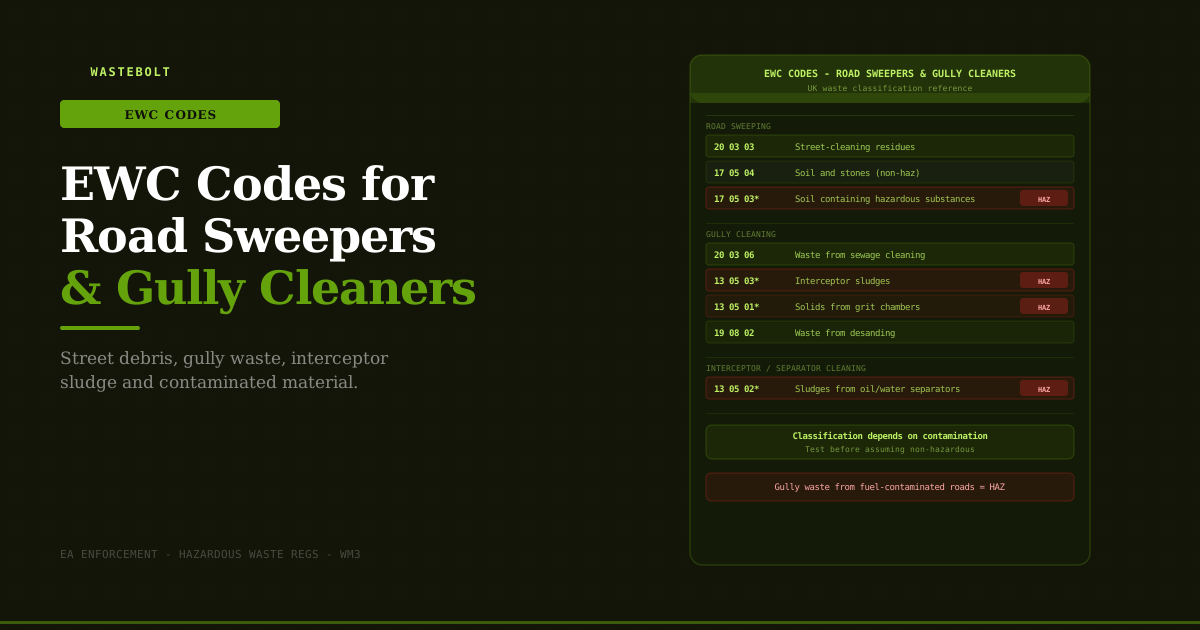
EWC Codes for Road Sweepers and Gully Cleaners — Why Classification Is Harder Than It Looks
Road sweeping and gully cleaning contractors face a classification challenge that most other waste businesses don't: the same waste stream can be non-hazardous one week and hazardous the next, depending entirely on where it came from and what's in it.
Street debris swept from a residential road is very different from gully waste extracted from drains on a fuel station forecourt. The physical appearance may be similar — both are dark, wet, mixed material — but their regulatory classification and documentation requirements can be completely different.
This guide covers every EWC code relevant to road sweeping and gully cleaning operations, the critical factors that determine whether waste is hazardous, and what documentation is required for each.
Tip: Not sure which EWC code applies to a specific waste stream? Use our free EWC Code List & Search Tool to search the full UK Waste Classification system by keyword or code.
The Core Problem: Contamination Determines Classification
Unlike most waste streams where the industry generating the waste gives a strong indication of EWC code, road sweeping and gully cleaning waste is highly variable. The same type of vehicle operating on the same type of road can produce:
- Non-hazardous street debris (leaf litter, grit, general litter) — standard WTN
- Hazardous contaminated material (fuel-soaked debris near petrol stations, road markings containing hazardous substances) — consignment note required
- Non-hazardous gully sediment from residential streets
- Hazardous gully waste from industrial estates or petrol forecourts where hydrocarbon contamination is present
The key regulatory principle: You cannot assume a waste is non-hazardous simply because it looks like it should be. Where there is any reasonable possibility of hazardous contamination based on the location of collection, either test the waste or treat it as hazardous.
Road Sweeper Waste — EWC Codes
20 03 03 — Street-Cleaning Residues
Hazardous: No (in standard classification)
This is the primary EWC code for general road sweeper collections from public highways, residential streets, car parks, and pedestrian areas. It covers the mixed material collected by mechanical sweepers — grit, sand, leaf litter, litter, small debris — where there is no specific hazardous contamination.
20 03 03 sits in Chapter 20 (municipal wastes) because street cleaning is historically a local authority function, though the code applies equally to private contractors.
When 20 03 03 is correct:
- Residential and suburban road sweeping
- Town centre and pedestrian area sweeping
- Car park sweeping where there is no known fuel or chemical contamination
- General highway maintenance sweeping
Documentation: Standard Waste Transfer Note required. The carrier needs a waste carrier registration. The receiving site must be authorised to accept this waste — typically a waste transfer station or landfill with a permit covering this waste type.
Practical note for contractors: Where you are sweeping multiple locations under a regular contract — local authority street cleaning, for example — a Season Ticket may be appropriate if the same waste type is consistently produced. This avoids the need for a new WTN for every load.
17 05 04 — Soil and Stones Other Than Those Mentioned in 17 05 03
Hazardous: No
Where sweeper debris consists predominantly of mineral material — grit, sand, stone fragments — and the source location does not create a risk of hazardous contamination, 17 05 04 may be more specific than 20 03 03.
This code is most applicable where sweeping has produced largely clean mineral aggregate — for example, following road surface repairs or in rural highway maintenance contexts.
Documentation: Standard Waste Transfer Note required.
17 05 03* — Soil and Stones Containing Hazardous Substances
Hazardous: Yes
Where road sweeper debris is contaminated with hazardous substances — hydrocarbons from road spillages, heavy metals from road markings, PAHs from degraded road surfaces, or other hazardous materials — the correct code is 17 05 03* rather than the non-hazardous equivalents.
Situations where 17 05 03 may apply:*
- Sweeping following a vehicle fuel spill
- Debris from roads with known hydrocarbon contamination
- Material from industrial areas where hazardous substance spillage is likely
- Sweeper debris that fails a hydrocarbon test
- Areas with old road markings containing lead or other hazardous substances
Documentation: Hazardous Waste Consignment Note required. The carrier must hold an Upper Tier waste carrier registration. The receiving site must hold a permit for hazardous waste.
Gully Cleaning Waste — EWC Codes
Gully cleaning waste is significantly more complex than road sweeper debris. Gullies accumulate everything that washes off the road surface — sediment, hydrocarbons, metals, organic material — and the resulting waste is frequently contaminated.
20 03 06 — Waste from Sewage Cleaning
Hazardous: No (in standard classification)
This is the primary EWC code for gully cleaning waste — the silt, sand, and debris extracted from road drainage gullies — where contamination levels are within non-hazardous thresholds.
20 03 06 applies to gully waste from:
- Residential street drainage gullies
- Highway drainage gullies in non-industrial areas
- General urban drainage maintenance
Documentation: Standard Waste Transfer Note required in most cases. The receiving site is typically a specialist gully waste treatment and recycling facility, licensed transfer station, or permitted landfill.
The contamination caveat: 20 03 06 is the starting assumption for standard gully waste, but it is not automatically correct for all gully cleaning. See the contamination section below.
13 05 03* — Interceptor Sludges
Hazardous: Yes
Where gully cleaning involves the extraction of material from petrol interceptors, oil/water separators, or gullies in petrol station forecourts, fuel depots, or industrial areas with known hydrocarbon contamination, the waste is classified as interceptor sludge — 13 05 03* — and is hazardous.
The distinction between 20 03 06 (non-hazardous gully waste) and 13 05 03* (hazardous interceptor sludge) is one of the most important and commonly misclassified distinctions in the road cleaning sector.
13 05 03 applies to gully cleaning at:*
- Petrol station forecourts
- Fuel distribution depots
- Commercial vehicle washing facilities
- Industrial sites with oil or chemical handling
- Any location where an oil/water interceptor is present in the drainage system
- Motorway service areas
- Airport aprons and taxiways
Documentation: Hazardous Waste Consignment Note required. The material must be handled by a contractor licensed for hazardous waste and sent to a permitted hazardous waste treatment facility.
13 05 01* — Solids from Grit Chambers and Oil/Water Separators
Hazardous: Yes
Where gully cleaning involves the physical removal of solids from grit chambers or the solid fraction separated from an oil/water interceptor system, 13 05 01* is the correct code rather than 13 05 03*.
The distinction:
- 13 05 01* — solid material (grit, sand, sediment) from within the interceptor or separator
- 13 05 02* — liquid sludge from oil/water separators
- 13 05 03* — interceptor sludge (mixed solid and liquid from drainage systems with hydrocarbon contamination)
In practice, gully cleaning contractors removing material from petrol station drainage systems will often produce a combination of 13 05 01* and 13 05 03*, which should be segregated if possible or classified as the most hazardous component if mixed.
Documentation: Hazardous Waste Consignment Note required for all 13 05 xx* codes.
19 08 02 — Waste from Desanding
Hazardous: No
Where gully waste is processed through a desanding or grit separation plant before disposal, the separated sand/grit fraction may be classified as 19 08 02 (waste from desanding) if it has been adequately treated and meets non-hazardous thresholds.
This code is relevant for contractors or transfer stations that process gully waste on-site, separating the material into clean aggregate (19 08 02) and residual contaminated material for further treatment.
Documentation: Standard WTN for the treated desanded fraction, assuming non-hazardous thresholds are met.
The Contamination Decision — How to Classify Correctly
For both road sweepers and gully cleaners, the location of collection is the primary determinant of EWC code. The following framework helps decide:
Step 1: Where did the material come from?
| Location | Starting assumption |
|---|---|
| Residential streets | Non-hazardous (20 03 03 / 20 03 06) |
| Town centres / car parks (no fuel history) | Non-hazardous |
| Industrial estate roads | Assume hazardous until tested |
| Petrol station forecourts | Hazardous (13 05 03*) |
| Motorway / trunk road | Assume hazardous — test |
| Road following fuel spillage | Hazardous (17 05 03*) |
| Flood-affected roads (mixed source) | Assume hazardous — test |
Step 2: Has there been visible contamination?
Oil sheens on collected water, strong hydrocarbon odour, or visual contamination are indicators that the material should be treated as hazardous regardless of source location. Trust the evidence on the ground.
Step 3: Test or treat as hazardous
Where the source creates any reasonable doubt, either commission a waste characterisation test (total petroleum hydrocarbons, pH, heavy metals) or classify as hazardous and use a consignment note. The cost of incorrect classification — fines, clean-up costs, permit risk — significantly outweighs the cost of a test.
Documentation Challenges for Mixed Operations
Many road sweeping and gully cleaning contractors operate across a range of site types in a single day — residential streets in the morning, a petrol station in the afternoon. This creates a documentation challenge because different loads on the same vehicle may have different EWC codes and different documentation requirements.
Best practice for mixed operations:
Segregate loads by classification where possible. If the vehicle can be emptied between the non-hazardous residential work and the hazardous petrol station gully job, do so. This makes documentation straightforward — one WTN for the residential material, one consignment note for the petrol station material.
Where mixing has occurred, classify conservatively. If hazardous and non-hazardous material has been mixed in the same tank, the entire load is hazardous. You cannot unmix it. Use a consignment note for the full load.
Keep site records. For each location cleaned, record the date, address, and type of site. This creates the audit trail that supports your EWC code choice if questioned during an EA inspection.
Use digital WTNs that allow job-by-job recording. Paper systems make it hard to maintain separate records for different jobs on the same day. A digital system where each site generates its own WTN or docket — linked to a season ticket for regular locations — gives you complete traceability.
Season Tickets for Regular Contracts
Many road sweeping and gully cleaning contracts involve the same sites cleaned on a regular cycle — weekly, monthly, quarterly. Where:
- The same waste type is produced each time (e.g. consistently non-hazardous 20 03 03 from a residential contract)
- The same carrier collects
- The same disposal site receives the material
...a Season Ticket covers all collections under the contract without needing a new WTN for every visit. Each individual load still needs a docket (date, vehicle, weight), but the full WTN documentation is completed once.
Season tickets are not available for hazardous waste — every hazardous consignment requires its own note.
Liquid Waste and Tanker Operations
Gully cleaning typically involves tanker vehicles extracting liquid and semi-liquid material alongside solid debris. The liquid fraction requires separate consideration:
20 03 06 covers the full gully waste extraction including liquid content in standard residential/urban contexts.
13 05 02* — Sludges from oil/water separators — applies to the liquid fraction from petrol station and industrial gully cleaning where hydrocarbon content makes the liquid hazardous.
For tanker operators, the tankered liquid fraction from hazardous sites must be kept separate from non-hazardous loads, documented separately, and discharged only at a facility permitted to receive hazardous liquid waste.
EWC Code Quick Reference
| Operation | EWC Code | Hazardous? | Document |
|---|---|---|---|
| Road sweeping — residential/urban | 20 03 03 | No | WTN |
| Road sweeping — mineral debris | 17 05 04 | No | WTN |
| Road sweeping — contaminated/spillage | 17 05 03* | Yes | Consignment Note |
| Gully cleaning — residential | 20 03 06 | No | WTN |
| Gully cleaning — petrol station/industrial | 13 05 03* | Yes | Consignment Note |
| Grit chamber solids | 13 05 01* | Yes | Consignment Note |
| Oil/water separator sludge | 13 05 02* | Yes | Consignment Note |
| Desanded gully grit (treated) | 19 08 02 | No | WTN |
EA Enforcement and the Road Cleaning Sector
The Environment Agency is well aware that the road sweeping and gully cleaning sector has historically had inconsistent compliance with waste classification and documentation. Common enforcement findings include:
- Hazardous gully waste from petrol stations being transported and disposed of as non-hazardous 20 03 06 without testing
- No documentation at all for gully cleaning — particularly common in smaller operators
- Standard WTNs used for interceptor sludge that clearly required consignment notes
- Mixed loads of hazardous and non-hazardous material with only a non-hazardous WTN
EA enforcement can result in fixed penalty notices, vehicle seizure, and in serious cases prosecution with unlimited fines. Carriers found operating without correct documentation also risk their waste carrier registration.
The simplest demonstration of compliance during an EA stop is a complete, legible, correctly classified WTN or consignment note for the load being carried — ideally digital, timestamped, and instantly retrievable on a phone.
Frequently Asked Questions
Is all gully cleaning waste hazardous? No. Gully waste from residential streets and standard urban drainage is typically non-hazardous (20 03 06). Gully waste from petrol stations, fuel depots, and industrial sites with hydrocarbon drainage is hazardous (13 05 03*). The source determines the classification.
Do I need to test every load? Not necessarily. Where the source location consistently produces non-hazardous material and there is no visible contamination, non-hazardous classification is defensible without individual load testing. For borderline locations — industrial areas, mixed-use sites — waste characterisation testing is recommended and provides documentary evidence of classification decisions.
Can I use a season ticket for my local authority sweeping contract? Yes, if the waste type produced is consistently the same (same EWC code) and the contract involves the same carrier and disposal route. Season tickets are only available for non-hazardous waste.
What if I'm not sure whether a road has been contaminated? Treat it as hazardous and use a consignment note. The cost and admin burden of a consignment note is significantly less than the penalty for incorrectly classifying hazardous waste as non-hazardous.
Does DWT 2026 affect gully cleaning contractors? Phase 1 (October 2026) covers permitted receiving sites — the treatment and disposal facilities that accept your waste. Phase 2, covering carriers, is expected from around October 2027. However, receiving sites will be DWT-compliant from October 2026 and will require accurate structured waste data on incoming loads, making correct EWC classification more important than ever.
Is liquid gully waste treated differently from solid debris? Yes — the liquid fraction from hazardous sites is typically classified separately (13 05 02* or 13 05 03*) from solid debris and requires different handling, transport, and disposal routes. Segregation of liquid and solid hazardous fractions is good practice and simplifies classification.
Last updated: May 2026. EWC codes sourced from the UK Waste Classification Technical Guidance (WM3). Legal basis: Hazardous Waste (England and Wales) Regulations 2005 · Environmental Protection Act 1990 · Duty of Care Regulations 1991.