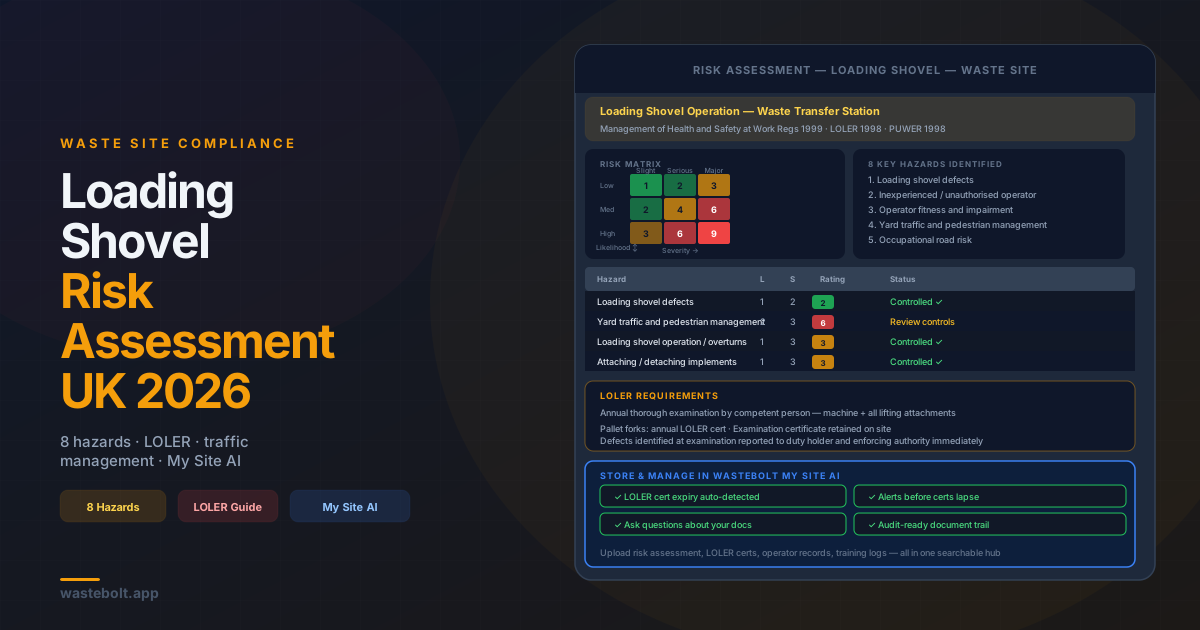
Why Waste Sites Need a Loading Shovel Risk Assessment
Loading shovels are one of the most commonly operated pieces of mobile plant on waste transfer stations, skip yards, recycling facilities, and composting sites. They are also one of the most significant sources of serious injury and fatality across the waste and recycling sector.
A loading shovel risk assessment is a legal requirement under the Management of Health and Safety at Work Regulations 1999. Every employer must conduct a suitable and sufficient assessment of the risks associated with work activities — including the operation of mobile plant — and implement effective control measures. Where five or more employees are employed, the assessment must be recorded in writing.
For waste sites, the loading shovel risk assessment sits alongside your environmental permit conditions, your site waste management plan, and your other operational RAMS (Risk Assessment and Method Statements). It forms part of the documented evidence that your site is operated safely — evidence that the Health and Safety Executive (HSE), the Environment Agency, and insurers may request.
This guide covers the eight key hazard areas for waste site loading shovel operations, the control measures required for each, LOLER obligations, record keeping requirements, and how to store and manage your risk assessments digitally.
Who Is at Risk on a Waste Site?
On a farm or agricultural setting, loading shovel risk is largely contained within the farm boundary with limited third-party exposure. A waste transfer station or recycling yard is significantly more complex:
- The operator — the primary risk, operating heavy plant in a busy yard
- Other site employees — working alongside the loading shovel in the tipping hall, on the sorting line, or in the yard
- HGV and skip lorry drivers — manoeuvring vehicles in the same yard space as the loading shovel
- Agency and contract staff — who may not have received the site induction
- Maintenance contractors — working on plant in or near the operational area
- Visitors and auditors — entering the site for compliance checks, client visits, or EA inspections
- Members of the public — particularly relevant for waste sites adjacent to public roads or with self-tip access
The interaction between a loading shovel and incoming HGV traffic is one of the highest-risk scenarios on a waste site and must be explicitly addressed in both the risk assessment and the site traffic management plan.
The Eight Key Hazards — Waste Site Context
1. Loading Shovel Defects
The hazard: The machine enters service with an existing defect, or develops a defect during the shift, that compromises safe operation — hydraulic failure, brake deficiency, steering fault, visibility obstruction.
Control measures for waste sites:
- Daily pre-start inspection by the operator before the machine enters service, recorded in the site defect book
- Clear procedure for reporting defects — any defect that affects safe operation takes the machine out of service immediately until rectified
- Planned preventative maintenance schedule maintained to at least the manufacturer's recommended intervals
- Annual thorough examination under LOLER (Lifting Operations and Lifting Equipment Regulations 1998) for the machine and all lifting attachments including pallet forks and grabs
- Defect records, service records, and LOLER examination certificates retained on site and available for inspection
Risk rating guidance: With pre-start checks, regular servicing, and LOLER compliance in place, likelihood of defect-related harm is low. Without these controls, likelihood increases significantly.
2. Inexperienced or Unauthorised Operators
The hazard: The loading shovel is operated by someone without the training, competency, or authorisation to do so safely — including agency workers, contractors, or employees who have not completed formal competency assessment.
Control measures for waste sites:
- All loading shovel operators must hold a relevant plant operator competency certificate — NPORS (National Plant Operators Registration Scheme) or CPCS (Construction Plant Competence Scheme) loading shovel category
- A written list of authorised operators is maintained by site management and reviewed when personnel changes occur
- No operator under 18 years of age
- Induction for all new operators including site-specific familiarisation with the waste yard layout, traffic routes, and tipping procedures before unsupervised operation
- Regular competency reviews — at least annually — and toolbox talks on safe operating practices
- Contractors bringing their own operators must provide evidence of operator competency before work commences
3. Operator Fitness and Impairment
The hazard: The operator is unfit to operate the machine safely due to fatigue, illness, alcohol, drugs (including prescription medication), or another factor affecting concentration or reaction time.
Control measures for waste sites:
- Written drugs and alcohol policy, communicated to all staff and contractors, with zero tolerance for operating plant under the influence
- Operators have a duty to declare if they are unfit to operate — including prescription medication that may affect driving ability or reaction time
- Operators who wear corrective lenses must wear them when operating the loading shovel
- Fatigue management — shift patterns and task rotation considered to reduce extended periods of loading shovel operation
4. Yard Traffic Management and Pedestrian Segregation
The hazard: The loading shovel collides with an HGV, skip lorry, car, or pedestrian in the yard due to inadequate traffic management, poor visibility, or failure to follow site rules.
This is one of the highest-risk hazard areas on a waste site and requires particular attention. A busy transfer station may have dozens of vehicle movements per hour in the same yard space as the operating loading shovel.
Control measures for waste sites:
- Written yard traffic management plan with clearly defined vehicle routes, pedestrian routes, and prohibited zones
- Physical segregation where possible — barriers, kerbs, or designated pedestrian walkways separated from vehicle routes
- Site induction covering yard rules for all employees, contractors, drivers, and visitors before entry — induction records signed and retained
- Speed limits imposed and enforced — signage visible at site entrance and throughout the yard
- Loading shovel fitted with reversing alarm and adequate working lights
- Operator pre-start check includes mirrors, windows, and camera systems where fitted — any visibility obstruction must be corrected before operation
- Banksman or spotter used for high-risk reversing operations where visibility is restricted
- Exclusion zones around tipping operations clearly communicated and enforced
5. Occupational Road Risk
The hazard: The loading shovel is operated on a public road — for example travelling between adjacent site areas, or accessing a weighbridge on a public road — and is involved in a collision with another road user.
Control measures for waste sites:
- All operators driving the loading shovel on a public road hold a full UK driving licence
- Pre-start check confirms all road-legal lighting is operational before any public road use
- Operators comply with the Highway Code and all road traffic legislation while on a public road
- Loading shovel travel on public roads is minimised — routes reviewed and alternatives considered where possible
- Machine flagged with oversize load warning where dimensions require it
6. Attaching, Detaching, and Adjusting Implements
The hazard: The operator or another person is crushed, trapped, or entangled during the attachment or detachment of implements — bucket, grab, pallet forks — or during hydraulic hose connection and disconnection.
Waste site loading shovels typically operate with multiple implements including bulk handling buckets, orange peel grabs, and pallet forks. Implement changes are a routine activity with significant crush and entanglement risk.
Control measures for waste sites:
- Safe Stop procedure observed every time the cab is exited and whenever implements are changed: handbrake applied, all controls in neutral, hydraulics de-pressurised, engine off, key removed
- No person to position themselves in a crush zone or entanglement zone during implement changes
- Correct PPE — non-puncture gloves when handling hydraulic hoses, safety footwear throughout
- Pre-start check includes inspection of all implements in use that shift
- Quick-hitch systems inspected as part of the daily pre-start check — any fault with the quick-hitch takes the machine out of service
7. Implement Defects
The hazard: A loading shovel attachment — pallet forks, grab, bucket — has a defect that causes failure during operation, resulting in a dropped load or loss of control.
Control measures for waste sites:
- Daily pre-start inspection includes all implements in use that shift
- Pallet forks and lifting attachments undergo annual LOLER thorough examination — examination certificate retained on site
- Any implement showing signs of cracking, distortion, or excessive wear is taken out of service immediately
- Hydraulic hoses inspected for wear, chafing, or leaks at pre-start
8. Loading Shovel Operation — Overturns and Instability
The hazard: The loading shovel overturns, tips, or loses stability during operation — carrying an overloaded bucket, operating on uneven ground, turning with the boom raised, or travelling at speed on poor ground.
On waste sites, ground conditions vary — tipping hall floors can be contaminated, slippery, or uneven. Waste materials vary significantly in density. Operators must understand the machine's limits in this specific operating environment.
Control measures for waste sites:
- Operators trained to operate within the machine's manufacturer limits at all times — Safe Working Load (SWL) never exceeded
- Loading operations conducted on flat, even ground wherever possible — site layout reviewed to ensure tipping areas are maintained
- Boom not raised while turning — travel with load at carry height
- No lifting that raises the rear wheels off the ground
- No passengers in the cab at any time
- No persons transported on any attachment
- Safe Stop procedure practised every time the cab is exited
- Three points of contact when entering or exiting the cab
- Any defect occurring during operation reported to management immediately — machine taken out of service until rectified
- Operator competency reviewed regularly — overconfidence and complacency are significant risk factors in experienced operators
PPE Requirements for Waste Site Loading Shovel Operation
As a minimum:
- Safety footwear — steel-toecap, to at least EN ISO 20345, worn at all times when operating
- Non-puncture gloves — required when handling hydraulic hoses and attachments
- High-visibility clothing — required in the yard at all times for all persons
- Hard hat — required in designated areas of the site
Site-specific PPE requirements should be assessed and documented — waste sites with significant dust, chemical, or biological hazard may require additional respiratory protection.
LOLER Requirements for Loading Shovels
The Lifting Operations and Lifting Equipment Regulations 1998 (LOLER) apply to loading shovels when they are used for lifting operations — including lifting waste materials with a grab, or lifting palletised loads with pallet forks.
Key LOLER obligations:
Thorough examination: The loading shovel must undergo a thorough examination by a competent person at least every 12 months. Any lifting attachments — pallet forks, grabs — must also be examined at least annually, or every 6 months if used to lift persons (not applicable for waste site operations in most cases).
Examination certificate: The thorough examination must produce a written report. This certificate must be kept available for inspection and retained for the periods specified in the regulations — at least 2 years for equipment not used to carry persons, or until the equipment is no longer in service if used to carry persons.
Defects: If the thorough examination identifies a defect that is or could become a danger to persons, the competent person must notify the duty holder immediately and send a copy of the report to the relevant enforcing authority.
Record keeping on site: Both the LOLER examination certificate and the daily pre-start defect records should be retained on site and readily accessible during EA and HSE inspections.
Record Keeping Requirements
A loading shovel risk assessment for a waste site requires the following supporting records to be maintained:
- Daily pre-start defect records — completed by the operator each shift, retained for at least one year
- Maintenance and service records — recording all planned and reactive maintenance, the date, work carried out, and who signed it off
- LOLER examination certificates — for the loading shovel and all lifting attachments
- Operator competency records — certificates, authorisation records, competency review dates
- Toolbox talk records — date, topic, attendees, signatures
- Site induction records — signed acknowledgement from every employee, contractor, and regular visitor that they have received and understood the yard induction
- Risk assessment employee training record — signed by each employee to confirm they have read and understood the risk assessment
All of these records may be requested during an HSE investigation following an incident, during an insurance claim, or during an Environment Agency site audit.
Storing and Managing Your Risk Assessment Digitally
Paper risk assessments and maintenance records create the same problems as paper WTNs — they get lost, damaged, or filed away where nobody can find them. When an inspector arrives or an incident occurs, the time pressure to produce the right document from the right folder is significant.
WasteBolt's My Site AI compliance document hub is designed for exactly this type of document management. Upload your completed loading shovel risk assessment, LOLER certificates, operator competency records, and maintenance logs to My Site AI, and the system:
- Extracts expiry dates automatically — LOLER certificates due for renewal, competency certificates expiring, risk assessment review dates — and alerts you before they lapse
- Stores all documents permanently in a searchable, cloud-based hub accessible from any device
- Answers questions about your documents in plain English — "when is the next LOLER inspection due?", "which operators are authorised to use the loading shovel?", "when was the loading shovel last serviced?"
- Produces an audit-ready document trail — every document is timestamped and versioned
For a waste site with multiple pieces of plant, multiple operators, and a steady stream of LOLER certificates, training records, and permit conditions to manage, My Site AI replaces the filing cabinet with a system that proactively tells you what needs attention before it becomes a compliance gap.
Reviewing and Updating the Risk Assessment
A loading shovel risk assessment must be reviewed:
- At least annually
- After any accident or near-miss involving the loading shovel
- When a new operator is added to the authorised list
- When a new implement or attachment is added to the machine
- When there is a significant change to the yard layout or traffic management arrangements
- When a new hazard is identified that was not captured in the original assessment
When the review results in a change to control measures, all operators must be retrained on the updated assessment and sign the training record.
Frequently Asked Questions
Do I need a risk assessment if I only have one loading shovel operator? Yes. The obligation to conduct and record a risk assessment applies regardless of the number of employees. With fewer than five employees you are not legally required to record it in writing, but it is strongly recommended — particularly on a waste site where HSE and EA inspections can occur.
Does the loading shovel risk assessment replace the site traffic management plan? No. They are separate documents that complement each other. The traffic management plan covers the broader site — all vehicle and pedestrian movements. The loading shovel risk assessment focuses specifically on the hazards associated with operating that piece of plant. Both are required.
Who can carry out a LOLER thorough examination on a loading shovel? A competent person — typically a specialist engineer employed by an independent inspection body such as a hire company with an in-house engineer, or a third-party inspection service. The HSE defines "competent" as having sufficient practical and theoretical knowledge and experience to detect defects and assess their significance.
How long do I need to keep loading shovel maintenance records? There is no single statutory retention period for maintenance records, but best practice is to retain them for the working life of the machine. LOLER examination certificates must be retained for at least 2 years after the equipment is taken out of service.
Can I use WasteBolt to store all my site compliance documents? Yes. My Site AI within WasteBolt is designed for waste site compliance document management — risk assessments, LOLER certificates, environmental permit conditions, insurance documents, and operator training records can all be uploaded and managed in one place.
Last updated: June 2026. This guide is for educational purposes — your risk assessment must be site-specific. Legislation referenced: Management of Health and Safety at Work Regulations 1999 · LOLER 1998 · PUWER 1998 · Health and Safety at Work Act 1974.