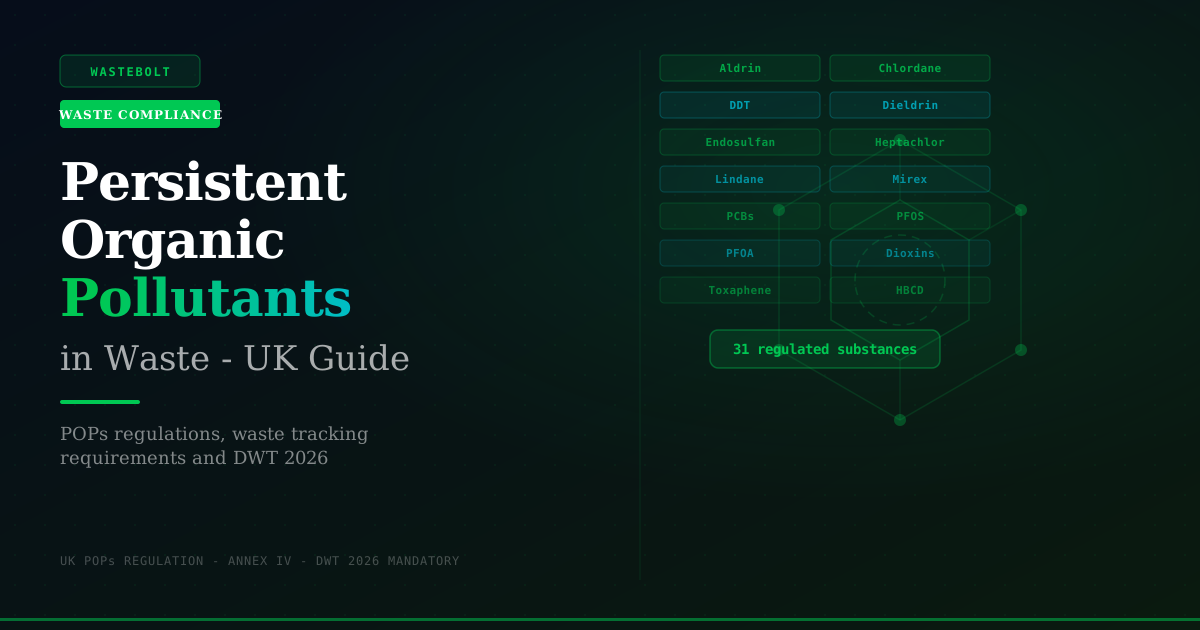
What Are Persistent Organic Pollutants?
Persistent Organic Pollutants — POPs — are chemical substances that do not break down in the environment. They persist in soil, water, and living organisms for years or decades, accumulating in the food chain and causing harm to human health and ecosystems long after the original source has been removed.
The key characteristics of POPs are:
- Persistence — they resist environmental degradation through chemical, biological, and photolytic processes
- Bioaccumulation — they accumulate in the fatty tissue of living organisms, concentrating as they move up the food chain
- Long-range transport — they can travel vast distances from their source through air and water, meaning they are found in environments far from where they were used
- Toxicity — they cause adverse effects including cancer, endocrine disruption, reproductive harm, and immune system damage
For waste management purposes, POPs are regulated under the UK POPs Regulation (retained from EU Regulation 2019/1021), which sets maximum concentration limits for regulated substances in waste.
Why POPs Matter for Waste Carriers and Receivers
The critical point for anyone involved in waste transfer is this: POPs can be present in waste that would otherwise be classified as non-hazardous.
A waste stream that contains no other hazardous properties may still require a Hazardous Waste Consignment Note and the HP POP classification if it contains regulated POPs above the Annex IV threshold concentrations. This is explicitly stated in the Defra DWT API documentation and the UK Waste Classification Technical Guidance.
This means the question "does this waste contain POPs?" must be asked across all waste streams — not just those that are obviously hazardous.
The 31 Regulated POPs in UK Waste Regulations
The UK POPs Regulation sets specific concentration limits for 31 regulated substances. Waste containing these substances above the limits in Annex IV is classified as hazardous under HP POP and must be treated, disposed of, or recovered in a way that destroys or irreversibly transforms the POP content.
| Code | Chemical Name | Common Source in Waste |
|---|---|---|
| ALD | Aldrin | Legacy pesticide residues in soil and agricultural waste |
| CHL | Chlordane | Legacy pesticide in treated timber and contaminated soil |
| CLD | Chlordecone | Banana plantation soil contamination, legacy industrial waste |
| DDT | Dichlorodiphenyltrichloroethane | Agricultural soil contamination, legacy pesticide stores |
| DCF | Dicofol | Acaricide residues, agricultural waste |
| DLD | Dieldrin | Legacy pesticide in soil, treated timber, grain storage residues |
| END | Endosulfan | Agricultural waste, legacy pesticide residues |
| ENDN | Endrin | Legacy rodenticide residues, contaminated soil |
| HPT | Heptachlor | Legacy termite treatment residues, contaminated soil |
| HBB | Hexabromobiphenyl | Old flame retardant residues in plastics and textiles |
| HBCD | Hexabromocyclododecane | Expanded polystyrene insulation waste, EPS building materials |
| DECABDE | Decabromodiphenyl ether | Flame retardant plastics, electronics waste |
| HEPTABDE | Heptabromodiphenyl ether | Flame retardant foam and textiles |
| HEXABDE | Hexabromodiphenyl ether | Flame retardant materials |
| PENTABDE | Pentabromodiphenyl ether | Polyurethane foam, upholstery — common in WEEE |
| TETRABDE | Tetrabromodiphenyl ether | Flame retardant textiles and polymers |
| PBDES | Tetra-, penta-, hexa-, hepta-, deca-BDEs | Collective BDE flame retardants in mixed waste |
| HCB | Hexachlorobenzene | Fungicide residues, industrial process waste, contaminated soil |
| HCBD | Hexachlorobutadiene | Chemical industry waste, chlorinated solvent production residues |
| HCH | Hexachlorocyclohexanes (including Lindane) | Agricultural soil, treated timber, legacy pesticide stores |
| MRX | Mirex | Legacy flame retardant and pesticide residues |
| PCB | Polychlorinated biphenyls | Old electrical transformers and capacitors — very common |
| PCDD_PCDF | Polychlorinated dibenzo-p-dioxins/furans | Incineration residues, contaminated soil near industrial sites |
| PCNS | Polychlorinated naphthalenes | Old cable insulation, wood treatment waste |
| PCP | Pentachlorophenol | Treated timber, wood preservative waste |
| PFHXS | Perfluorohexane sulfonic acid | Firefighting foam residues, industrial waste |
| PFOA | Perfluorooctanoic acid | Non-stick coating production waste, industrial process residues |
| PFOS | Perfluorooctane sulfonic acid (and derivatives) | Firefighting foam (AFFF), metal plating waste, waterproofing |
| SCCPS | Short-chain chlorinated paraffins | Metalworking fluid waste, PVC plasticiser residues |
| TOX | Toxaphene | Legacy pesticide, particularly in cotton-growing regions |
| MRX | Mirex | Legacy insecticide in contaminated soil |
POPs in Non-Hazardous Waste — The Important Distinction
The Defra DWT data definitions explicitly state: "POPs can be present in hazardous and non-hazardous waste."
This is one of the most misunderstood aspects of waste classification, and it has direct practical implications for anyone completing waste transfer documentation.
Common Non-Hazardous Waste Streams That May Contain POPs
Soil and excavation spoil — seemingly clean soil from former agricultural or industrial land may contain legacy pesticide residues (aldrin, dieldrin, DDT, lindane) or industrial contaminants (PCBs, dioxins). The soil EWC code 17 05 04 is non-hazardous but the soil may require testing before transfer if the site has any contamination history.
Construction waste — EPS insulation boards containing HBCD, old cable insulation containing PCNS, PVC materials containing SCCPs. Many construction materials manufactured before 2010 contain POPs that are now regulated.
Furniture and upholstered seating — pre-2004 polyurethane foam furniture may contain pentaBDE and other polybrominated diphenyl ethers. House clearance waste, office furniture disposal, and WEEE from older equipment may trigger POPs consideration.
Garden and biodegradable waste — soil from gardens near former orchards or market gardens may contain organochlorine pesticide residues from historical use.
Textiles — older industrial textiles and technical fabrics may have been treated with flame retardants now classified as POPs.
What This Means for Waste Transfer Documentation
If a non-hazardous waste stream is suspected to contain POPs above the Annex IV threshold concentrations, it must be classified as hazardous under HP POP and a Hazardous Waste Consignment Note must be completed — not a standard Waste Transfer Note.
The consignment note must include:
- The HP POP code
- Identification of the specific POP substances present
- Concentration values for each substance
POPs and the DWT 2026 API Requirements
From October 2026, Digital Waste Tracking becomes mandatory for all permitted waste receiving sites across England, Wales and Northern Ireland. The Defra DWT API includes specific data fields for POPs that go beyond what is currently required on a paper consignment note.
For waste movements containing POPs, the DWT submission must include:
wasteItems: [
  {
    containsPops: true,
    pops: [
      {
        name: "PFOS",
        concentration: {
          value: 50,
          unit: "mg/kg"
        }
      },
      {
        name: "PCB",
        concentration: {
          value: 25,
          unit: "mg/kg"
        }
      }
    ]
  }
]
The containsPops flag is mandatory for every waste item — it must be explicitly set to true or false. Where POPs are present, the individual substance names and concentrations must be provided for each POP component.
Critical point for software integration: The DWT API separates containsPops and containsHazardous as independent boolean flags. A waste item can have containsPops: true and containsHazardous: false — representing a non-hazardous waste that nonetheless contains POPs components. Both flags must be correctly populated for every waste movement.
PCBs — The Most Commonly Encountered POP in UK Waste
Polychlorinated biphenyls (PCBs) deserve specific mention as they are by far the most commonly encountered regulated POP in UK waste management.
PCBs were widely used in electrical transformers and capacitors manufactured before 1986, and in building materials including sealants, paints, and adhesives. Equipment containing PCBs at concentrations above 50mg/kg is classified as PCB waste and subject to specific disposal requirements under the UK PCB Regulations.
Where to look for PCBs in waste:
- Old electrical transformers (particularly distribution transformers from pre-1986)
- Old capacitors in industrial electrical equipment
- Building sealants in constructions from the 1950s–1980s
- Old fluorescent light ballasts
- Some rubber products and surface coatings
PCB waste must be disposed of by destruction — typically high-temperature incineration. It cannot go to standard landfill regardless of concentration.
PFAS — The Emerging Challenge
PFAS (per- and polyfluoroalkyl substances) — commonly called "forever chemicals" — are an increasingly significant concern in waste management. The UK POPs Regulation currently includes PFOS and PFOA as regulated substances, with PFHXS added more recently.
PFAS are found in waste from:
- Firefighting foam (AFFF) — sites with fire training areas or historical fire suppression use
- Metal plating and surface treatment facilities
- Semiconductor manufacturing waste
- Waterproofing treatments for textiles and paper
- Food packaging (some PFAS used in grease-resistant coatings)
The regulatory picture for PFAS in waste is evolving. Current threshold concentrations apply to PFOS, PFOA, and PFHXS under Annex IV of the UK POPs Regulation, but further PFAS substances may be added to the regulated list as scientific evidence develops.
Practical Guidance for Waste Carriers
Ask the right question before collection. Before classifying a waste stream as non-hazardous, consider whether the source site or material type creates any risk of POPs contamination. Former agricultural sites, pre-2000 building demolition, and electrical equipment disposal are the highest-risk categories.
When in doubt, test. Where POPs contamination is possible, laboratory analysis is the only reliable way to confirm concentrations. Testing costs are significantly lower than the regulatory consequences of misclassifying POPs-containing waste as non-hazardous.
Document the POPs assessment. Even where testing confirms POPs are below threshold concentrations, keeping records of the assessment demonstrates due diligence during any EA inspection or audit.
Use correct documentation from the start. If POPs are confirmed above Annex IV limits, a Hazardous Waste Consignment Note is required regardless of the waste's other properties. Do not attempt to carry POPs-contaminated waste on a standard Waste Transfer Note.
POPs in Wastebolt and DWT Submission
Wastebolt's hazardous waste forms capture POPs data as a separate section from other hazardous properties — reflecting the DWT API's treatment of POPs as independent from the containsHazardous flag.
When creating a hazardous consignment note in Wastebolt, you can:
- Identify that the waste contains POPs
- Select specific POP substances from the full list of 31 regulated compounds
- Record concentration values for each substance
- Generate a compliant consignment note with all POPs data included
- Submit directly to the DWT platform from October 2026
Start a free trial — no credit card required.
Frequently Asked Questions
Can a non-hazardous waste contain POPs? Yes. POPs can be present in waste streams that are otherwise non-hazardous. If the POPs concentration exceeds the limits in Annex IV of the UK POPs Regulation, the waste must be classified as HP POP (hazardous) and transferred on a Hazardous Waste Consignment Note regardless of its other properties.
What is Annex IV of the UK POPs Regulation? Annex IV is the schedule of concentration limits for regulated POPs in waste. Where a regulated substance is present at or above the listed concentration, the waste is classified as hazardous under HP POP and must be disposed of by destruction or irreversible transformation.
Are PFAS all regulated as POPs? Currently, PFOS, PFOA, and PFHXS are specifically regulated under the UK POPs Regulation. Other PFAS substances are under ongoing scientific review and may be added to the regulated list. Check the current version of the UK POPs Regulation for the most up-to-date list of controlled substances.
How are PCBs disposed of? PCB waste must be destroyed — typically by high-temperature incineration at a facility licensed to receive PCB waste. It cannot go to standard landfill. Disposal must be documented on a Hazardous Waste Consignment Note with the PCB code identified.
Does DWT 2026 require POPs data for every waste movement?
The DWT API requires the containsPops field to be explicitly stated (true or false) for every waste item in every movement record. Where POPs are present, individual substance names and concentrations are also required. This applies to all waste movements submitted through the API, not just obviously hazardous ones.
What are BDEs? BDEs — bromodiphenyl ethers, also called polybrominated diphenyl ethers (PBDEs) — are a family of flame retardants used extensively in furniture foam, textiles, and plastics from the 1970s onwards. Several BDE congeners (tetra, penta, hexa, hepta, and deca-BDE) are now regulated as POPs. They are commonly found in pre-2004 upholstered furniture and electronic equipment.
Last updated: May 2026. For the most current list of regulated POPs and Annex IV concentration limits, refer to the UK POPs Regulation and the Environment Agency's waste classification guidance.