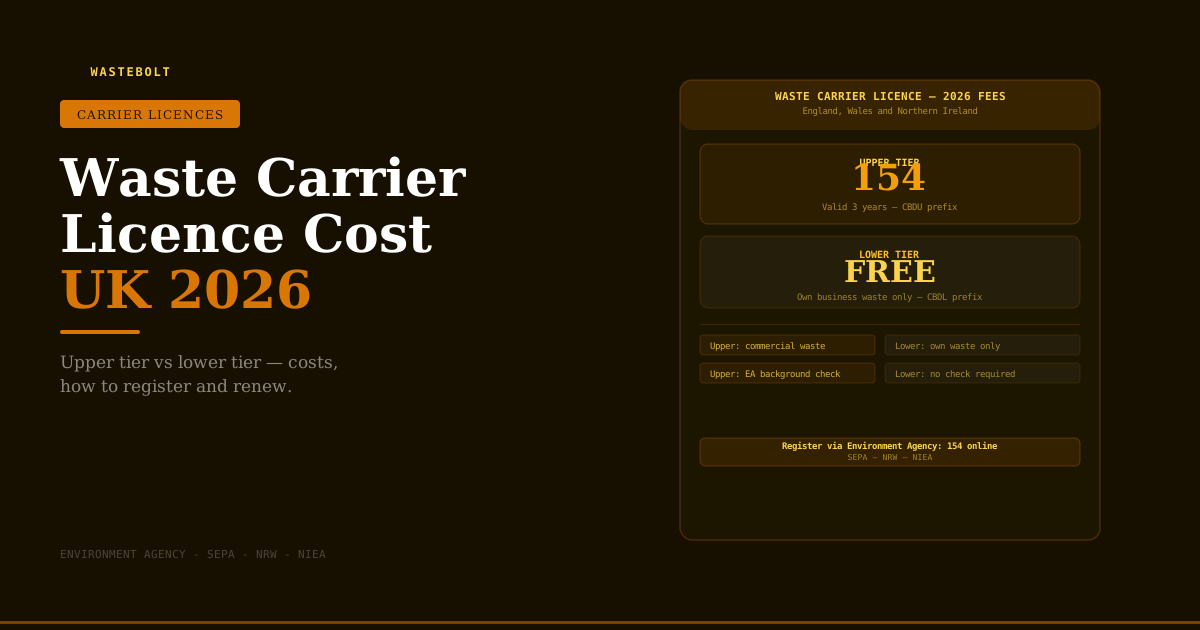
Waste Carrier Licence Costs at a Glance
| Licence Type | Registration Fee | Renewal Fee | Valid For |
|---|---|---|---|
| Upper Tier | £154 | £105 | 3 years |
| Lower Tier | Free | Free | Indefinitely |
Registration is handled online through the Environment Agency (England), SEPA (Scotland), NRW (Wales), or NIEA (Northern Ireland).
Upper Tier vs Lower Tier — What's the Difference?
This is where most people get confused. The two tiers are not just different price points — they cover fundamentally different activities.
Upper Tier Waste Carrier Licence
Cost: £154 to register, £105 to renew (2026 fees)
An Upper Tier licence is required if you:
- Collect or transport other people's waste for payment or as part of your business
- Buy, sell, or broker waste (even if you don't physically move it)
- Carry commercial, industrial, or construction waste for hire
This is the licence that skip hire companies, waste collection firms, man-and-van clearance operators, and waste brokers all need. If you are being paid to move someone else's waste, you need Upper Tier.
Upper Tier carriers are subject to an EA background check before registration is granted. The licence prefix is CBDU (Carrier Broker Dealer Upper Tier).
In Scotland: WCR/R/xxxxxxx In Northern Ireland: ROC UT xxxx
Renewal: Upper Tier licences are valid for 3 years. The renewal fee is £105. You will receive a reminder from the EA before expiry — but do not rely solely on this. Check your expiry date and renew before it lapses.
Lower Tier Waste Carrier Licence
Cost: Free
A Lower Tier licence covers businesses that carry only their own waste — waste that they produced themselves as a direct result of their normal business activities.
Examples of Lower Tier carriers:
- A plumber who takes their own waste pipe fittings and packaging to the tip
- A landscaping company that removes garden waste they produced while working on a client's garden
- A builder who skips their own construction site waste to a transfer station
The key distinction is that the waste must have been produced by the carrier themselves as a result of their own work. If a plumber is hired specifically to clear waste from someone else's property, that becomes Upper Tier activity.
Lower Tier registration is free and does not expire. The licence prefix is CBDL (Carrier Broker Dealer Lower Tier).
In Northern Ireland: ROC LT xxxx
Do I Need Upper Tier or Lower Tier?
The simplest test: are you moving your own waste or someone else's?
Your own waste → Lower Tier (free) Someone else's waste, or waste you've been paid to move → Upper Tier (£154)
If you're unsure, register Upper Tier. The consequences of operating under a Lower Tier licence when Upper Tier is required are the same as having no licence at all — potential prosecution and unlimited fines.
The most common mistake is builders and tradespeople assuming their Lower Tier registration covers everything. If a customer is paying you specifically to remove and dispose of waste from their property — even as part of a broader job — that's Upper Tier activity.
How to Register as a Waste Carrier
England
Register online through the Environment Agency: environment.data.gov.uk/public-register/waste-carriers-brokers
You'll need:
- Business name and address
- Company registration number (if applicable)
- Payment of £154 by debit or credit card
- To complete an EA background check (Upper Tier)
Processing time is typically 1–2 weeks for Upper Tier applications. Lower Tier registrations are usually processed more quickly.
Scotland
Register with SEPA: sepa.org.uk
The Scottish registration format is WCR/R/xxxxxxx. SEPA manages the registration process independently — fees and processing times may differ from the EA.
Wales
Register with Natural Resources Wales: naturalresources.wales
Wales uses the same CBDU/CBDL format as England.
Northern Ireland
Register with the Northern Ireland Environment Agency (NIEA): daera-ni.gov.uk
Northern Ireland uses the ROC UT (Upper Tier) and ROC LT (Lower Tier) format.
Renewal Costs and Process
| Action | Upper Tier | Lower Tier |
|---|---|---|
| Initial registration | £154 | Free |
| 3-year renewal | £105 | No renewal needed |
| Replacement certificate | £10 | £10 |
Upper Tier licences must be renewed every 3 years. If you let your registration lapse — even by a day — you are operating illegally. The EA does not provide a grace period.
Set a calendar reminder 3 months before your registration expires. The EA renewal portal is the same as registration — you'll need your existing registration number.
Lower Tier registrations do not expire and do not need to be renewed.
Your Registration Number on Waste Transfer Notes
Your waste carrier registration number must appear on every Waste Transfer Note you complete as the carrier. In the carrier section (Part B), the CBDU or CBDL number is a required field.
Producers are legally entitled — and in practice obligated — to check that your registration number is current before handing over waste. The EA public register is searchable and free to use.
An invalid or expired registration number on a WTN creates compliance problems for both the carrier and the producer. The producer could be held liable for the waste even after it left their premises.
Hazardous Waste Carriers
If you transport hazardous waste, you need an Upper Tier registration — Lower Tier does not cover hazardous material under any circumstances.
Additionally, the receiving site must hold a permit specifically covering the hazardous waste type. The documentation requirement changes from a standard WTN to a Hazardous Waste Consignment Note with HP codes and, where applicable, POPs declarations.
Read more about hazardous waste consignment notes →
What Happens If You Carry Waste Without a Licence?
Carrying controlled waste without a valid carrier registration is a criminal offence under Section 1 of the Control of Pollution (Amendment) Act 1989.
Penalties include:
- Seizure of the vehicle used to transport the waste
- Fixed penalty notices
- Prosecution in the Magistrates Court — fines up to £5,000
- Prosecution in the Crown Court — unlimited fines
The EA and local authorities carry out roadside checks on waste-carrying vehicles. Fly-tipping investigations routinely involve checking whether carriers were properly registered.
Waste Carrier Licence and DWT 2026
From October 2026, Digital Waste Tracking becomes mandatory for all permitted waste receiving sites across England, Wales and Northern Ireland. Your carrier registration number will be a required field in DWT submissions — exactly as it currently is on paper WTNs.
Wastebolt stores your carrier registration number and includes it automatically on every WTN and DWT submission. Start a free trial →
Frequently Asked Questions
How much does a waste carrier licence cost in 2026? Upper Tier: £154 to register, £105 to renew every 3 years. Lower Tier: free, no renewal required.
How long does it take to get a waste carrier licence? Typically 1–2 weeks for Upper Tier through the EA. Lower Tier is often processed more quickly. Allow more time if you need the licence urgently.
Can I carry waste before my registration is confirmed? No. You must have a confirmed registration before carrying controlled waste. Operating without a registration while an application is pending is still an offence.
Does my waste carrier licence cover all types of waste? Upper Tier covers all controlled waste including hazardous waste. Lower Tier covers only your own non-hazardous business waste. Check that your registration covers the specific waste types you intend to carry.
Do I need a separate licence for each vehicle? No. One Upper Tier registration covers your entire business and all vehicles you operate under that business name.
What is the difference between a CBDU and CBDL number? CBDU = Carrier Broker Dealer Upper Tier. CBDL = Carrier Broker Dealer Lower Tier. The prefix on your registration number shows which tier you are registered under.
Do sole traders need a waste carrier licence? Yes. There is no exemption for sole traders. If you carry controlled waste as part of your business — even occasionally — you need the appropriate registration.
Last updated: May 2026. Fees correct as of May 2026 — check the EA website for any updates. Legal basis: Control of Pollution (Amendment) Act 1989 · Environmental Protection Act 1990.