Waste Tracking on Construction Sites — Who Is Responsible for What
Construction and demolition sites generate more controlled waste than any other sector in the UK. They also generate more compliance confusion — because multiple parties are involved, waste is produced continuously across different work packages, and the split of responsibility between principal contractor, subcontractors, and waste carriers is frequently misunderstood.
This guide sets out the waste tracking obligations on a construction or demolition site clearly: who is responsible for what, what documentation is required for every waste stream, how to manage WTNs across multiple subcontractors, and what the October 2026 Digital Waste Tracking mandate means for sites with on-site waste facilities.
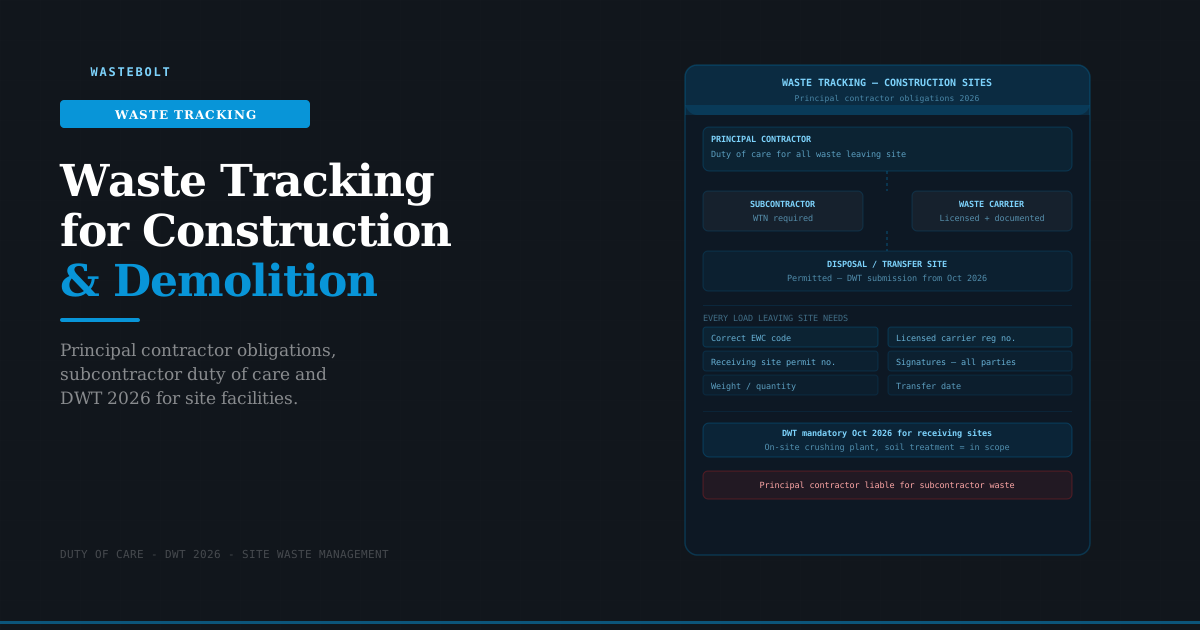
The Principal Contractor's Duty of Care
Under Section 34 of the Environmental Protection Act 1990, the duty of care applies to every person who produces, carries, keeps, treats, or disposes of controlled waste. On a construction or demolition site, this means:
- The principal contractor has duty of care for all waste generated on the site, regardless of which subcontractor generated it
- Each subcontractor has their own duty of care for waste they produce
- The waste carrier has duty of care for waste they collect and transport
- The receiving site has duty of care for waste they accept
The critical point principal contractors often miss: employing a subcontractor to carry out work does not transfer your duty of care to them for the waste they generate. If a subcontractor uses an unlicensed carrier to remove waste from your site, or fails to complete proper documentation, the principal contractor can be held liable.
This means the principal contractor must:
- Ensure all carriers removing waste from the site are properly registered
- Verify that waste is going to appropriately permitted receiving sites
- Ensure WTNs are completed for every waste movement
- Retain copies of all WTNs for at least 2 years
What Documentation Is Required for Every Load
Every load of controlled waste leaving a construction or demolition site requires a Waste Transfer Note. There are no exceptions for small quantities, short journeys, or "trade waste" arrangements.
A legally compliant WTN for a construction site movement must include:
Producer details (the site)
- Site name and full address
- Principal contractor or site owner details
- Relevant SIC code
- Any environmental permit or registered exemption held by the site
Carrier details
- Carrier name and address
- Waste Carrier Registration number — CBDU (Upper Tier) for commercial waste carriers
- Vehicle registration number
Receiving site details
- Name and address of the waste transfer station, recycling facility, or landfill
- Environmental permit number — confirm it covers the specific waste type being delivered
Waste description
- Specific description of the waste — not "building waste" or "skip waste" but a meaningful description
- Correct EWC code from Chapter 17 (see the companion EWC codes guide)
- Physical form and containment
- Quantity / weight
- Recovery or disposal code (R or D code)
Signatures from producer, carrier, and consignee.
For hazardous waste streams — asbestos, contaminated soil, coal tar asphalt, PCB-containing materials — a Hazardous Waste Consignment Note is required instead of a standard WTN. The consignment note has additional required fields including HP codes.
Managing WTNs Across Multiple Subcontractors
On a large construction or demolition project, the complexity compounds quickly. You might have:
- Groundworks contractor generating excavated soil
- Demolition contractor generating asbestos, masonry, and mixed C&D
- Fit-out contractors generating plasterboard, timber, and packaging
- M&E contractors generating cable offcuts, metal, and equipment
- Skip hire company collecting general site waste
- Specialist hazardous waste contractors collecting asbestos and contaminated soil separately
Each of these waste streams potentially has a different EWC code, a different carrier, and a different receiving site — and each movement needs its own WTN.
Practical approaches for managing this:
Appoint a site waste coordinator. On large sites, designating one person responsible for waste documentation — checking carrier registrations, ensuring WTNs are completed, chasing missing copies — prevents gaps.
Require subcontractors to provide WTN copies. Make it a contractual requirement that subcontractors provide copies of all WTNs for waste they generate and remove from site. Include this in subcontract agreements.
Use digital WTN software accessible to all parties. Paper WTN books create the inevitable problem of missing copies. Digital systems allow waste movements to be recorded centrally, with all parties receiving their copies automatically.
Use Season Tickets for regular same-type collections. Where the same subcontractor produces the same waste type repeatedly — a plastering contractor generating plasterboard offcuts weekly — a Season Ticket avoids the need for a new WTN every time while maintaining proper documentation.
Site Waste Management Plans
Site Waste Management Plans (SWMPs) were made a legal requirement for projects over £300,000 in England under the 2008 Site Waste Management Plans Regulations, but that requirement was repealed in 2013. SWMPs are no longer legally mandatory in England.
However, SWMPs remain best practice and are required by many clients — particularly public sector and housing association clients — under their own contract requirements. Several large contractors require SWMPs on all projects above certain values regardless of the regulatory position.
More importantly, the discipline that a SWMP creates — identifying waste streams in advance, appointing responsible persons, tracking quantities against estimates — naturally leads to better waste documentation and compliance.
A basic SWMP should cover:
- Identification of all expected waste streams and estimated quantities
- Designated storage areas for different waste types on site
- Appointed responsible person for waste management
- List of approved carriers and receiving sites
- Process for recording waste movements
- Reporting against planned vs actual waste quantities
On-Site Waste Treatment — When DWT 2026 Applies
Many larger construction and demolition projects operate on-site waste treatment facilities — a mobile crusher processing demolition rubble into recycled aggregate, a soil treatment plant processing contaminated excavation material, or a temporary waste transfer area where mixed C&D is sorted before onward movement.
The critical question for DWT 2026: Does your on-site facility constitute a "permitted waste receiving site"?
If your site holds an environmental permit or registered exemption that allows it to accept waste from other sources, or if it is processing waste in a way that requires a permit, it falls within scope of the October 2026 Digital Waste Tracking mandate. From October 2026, every waste movement received at a permitted on-site facility must be reported to the EA's DWT platform.
Common on-site situations and DWT scope:
| On-site facility | DWT scope from Oct 2026? |
|---|---|
| Mobile crusher on a registered T exemption | Yes — if accepting waste from third parties |
| On-site soil treatment under permit | Yes |
| On-site skip area (sorting own site waste only) | Typically no — check with EA |
| Temporary transfer station with permit | Yes |
| Crushing own demolition material only | Check exemption conditions |
If you're uncertain whether your on-site facility is in scope, contact the EA directly or seek advice from your environmental consultant. Getting this wrong — either by not submitting when required, or by submitting incorrectly — creates compliance risk.
Subcontractor Waste — Who Pays and Who Documents
The commercial and compliance aspects of subcontractor waste are often confused.
Commercially: Waste disposal costs may be the principal contractor's responsibility, the subcontractor's responsibility, or split — this depends on the contract. Whatever the commercial arrangement, it has no bearing on who must complete the WTN.
Legally for WTN purposes: The subcontractor is the producer of their waste. They must ensure their waste is described accurately, goes to a permitted site via a licensed carrier, and that a WTN is completed. The principal contractor must ensure this is happening across all subcontractors on site.
The common failure point: A subcontractor skips documentation because "the principal contractor handles all the waste." The principal contractor assumes subcontractors are handling their own documentation. Neither checks. EA inspection finds no documentation for a significant proportion of waste removed from site. Both parties face enforcement.
The cleanest arrangement: the principal contractor sets up a site-wide waste management system (ideally digital), all subcontractors use it to log waste movements, and the system generates WTNs automatically with all parties receiving copies.
Asbestos Waste — The Separate Track
Asbestos-containing material (ACM) from demolition and refurbishment is the most strictly regulated hazardous waste stream on C&D sites. It requires not just a Hazardous Waste Consignment Note but a specific licensed contractor chain.
The requirements:
Licensed asbestos removal contractor — for notifiable non-licensable work (NNLW) and licensable work, a licensed contractor is required. The HSE maintains a register of licensed asbestos contractors.
Hazardous Waste Consignment Note — for every movement of asbestos waste. The consignment note must correctly identify the type (17 06 01* for insulation, 17 06 05* for ACMs) and the HP codes (HP 7 — carcinogenic).
Permitted disposal facility — asbestos waste can only go to a licensed asbestos waste disposal site, typically a permitted asbestos cell at an appropriate landfill. It cannot go to a general skip.
Waste carrier registration — the carrier must hold Upper Tier registration and be specifically equipped for asbestos transport (sealed containers, appropriate vehicle).
Principal contractor obligation: Verify that the asbestos contractor holds a current HSE licence. Do not accept verbal assurances — check the HSE register. Keep copies of all asbestos consignment notes.
Contaminated Soil — The Testing and Classification Process
Excavated soil from brownfield sites is one of the most complex and high-value waste streams on demolition and infrastructure projects. Getting the classification right has significant commercial implications — contaminated soil (17 05 03*) disposal costs far more than clean soil (17 05 04).
The correct process:
- Desk study — review site history, historical maps, previous investigation reports to identify potential contamination sources
- Phase II ground investigation — physical sampling and chemical analysis of soil across the excavation footprint
- Waste acceptance criteria (WAC) testing — for material going to landfill, WAC testing determines which landfill tier can accept it
- Classification and documentation — assign EWC code based on test results, complete appropriate documentation (WTN or consignment note)
- Permitted disposal or treatment — ensure the receiving site's permit covers the specific contaminants present
Never assume soil is clean without evidence. The consequences of sending 17 05 03* material to a site only permitted for 17 05 04 are serious — for both the site generating the material and the receiving site accepting it.
Digital Waste Tracking for Construction Sites — Practical Setup
Running waste documentation on paper across a large demolition or construction project creates unnecessary risk and administrative burden. Digital systems provide:
Immediate benefits:
- Every waste movement logged in real time
- Carrier registration numbers checked and recorded
- WTNs generated and distributed to all parties automatically
- Missing documentation flagged before it becomes an audit issue
- All records instantly accessible during an EA site visit
DWT 2026 readiness:
- Data already captured in a format compatible with DWT submission
- No re-entry of information when DWT mandate applies to on-site facilities
For principal contractors managing multiple subcontractors, a digital system where all parties log waste movements into one platform gives you visibility of every WTN across the site in real time — something that is genuinely impossible with paper systems.
Start a free trial of Wastebolt →
Checklist — Waste Compliance on a Construction Site
- Waste carrier registration checked for every carrier removing waste from site (check EA public register)
- Receiving site permit confirmed for each waste type before first delivery
- WTN completed for every load leaving site
- Hazardous Consignment Note used for all hazardous streams (asbestos, contaminated soil, coal tar)
- Asbestos contractor HSE licence verified
- Subcontract agreements require waste documentation
- Copies of all WTNs retained on site and accessible
- Plasterboard segregated from biodegradable waste
- Asphalt planings tested before classification if road age uncertain
- On-site facility DWT scope assessed and preparation underway if in scope
- Season tickets in place for regular repeat collections of same waste type
Frequently Asked Questions
Is the principal contractor responsible if a subcontractor uses an unlicensed carrier? Yes — the principal contractor has a duty of care that includes ensuring waste from their site is handled legally. Using an unlicensed carrier, even unknowingly, can result in enforcement action against the principal contractor. Always verify carrier registrations.
Does a skip company's WTN satisfy the site's duty of care? Not on its own. The skip company's WTN covers their part of the chain as carrier. The site must also maintain its own records demonstrating the waste was properly described, the carrier was licensed, and the receiving site was permitted.
What if subcontractors won't provide WTN copies? This is a contractual matter — make WTN provision a contract requirement with financial consequences for non-compliance. From a regulatory perspective, the obligation exists regardless of whether the documentation has been provided. Pursue it.
Are domestic demolition projects exempt? No. The duty of care applies regardless of project size or whether the client is a householder. A sole trader demolishing a garden shed extension must still complete a WTN for the rubble removed.
Do site offices generate waste that needs WTNs? Office waste from site cabins — paper, food waste, packaging — is typically collected by commercial waste contractors under standard WTNs. This is separate from the C&D waste stream and is often managed through a commercial waste collection contract.
Last updated: May 2026. Legal basis: Environmental Protection Act 1990 · Duty of Care Regulations 1991 · Hazardous Waste (England and Wales) Regulations 2005.