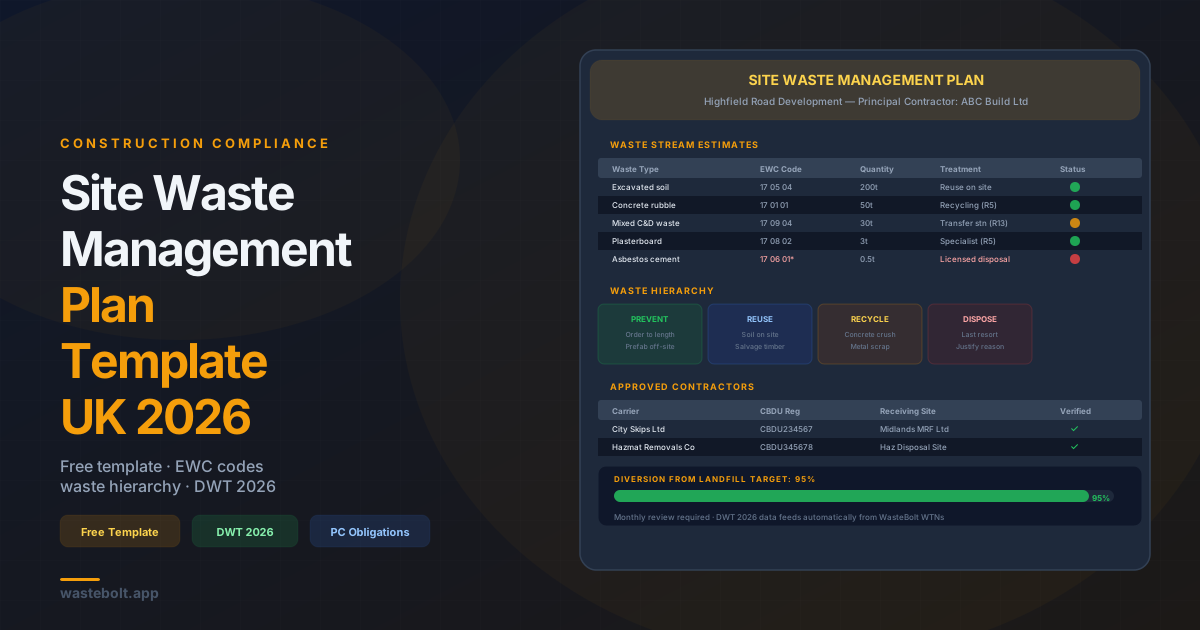
What Is a Site Waste Management Plan?
A Site Waste Management Plan (SWMP) is a document that records how waste will be managed on a construction project — what types of waste will be generated, how much, who will remove it, where it will go, and how the waste hierarchy will be applied.
SWMPs were a legal requirement in England from 2008 to 2013, when the Site Waste Management Plans Regulations 2008 were revoked. They are no longer a statutory requirement under national legislation. However, they remain a contractual requirement on most publicly funded projects, are required by many planning authorities as a planning condition, and are best practice on all significant construction sites.
More importantly, the information that goes into a SWMP directly feeds into the Waste Transfer Notes and Digital Waste Tracking submissions your project will need to produce. Getting the SWMP right at the start makes compliance throughout the project significantly easier.
Who Needs a Site Waste Management Plan?
Legally required — for projects where planning permission includes a condition requiring a SWMP. Check your planning decision notice.
Contractually required — most public sector contracts (government, NHS, local authority, housing associations) require a SWMP as a contract document. Private sector main contractors increasingly require sub-contractors to contribute to a SWMP.
Best practice — any construction project generating significant volumes of waste benefits from a SWMP, even without a legal or contractual obligation. Projects with a good SWMP generate less waste, produce better compliance documentation, and manage contractor obligations more effectively.
Principal contractor responsibility — where a principal contractor is appointed under CDM 2015, they are typically responsible for producing and maintaining the SWMP. Sub-contractors contribute waste estimates for their scope of work.
What a Site Waste Management Plan Must Include
While there is no longer a prescribed legal format, best practice SWMPs and most client requirements include the following sections:
1. Project details
- Project name, address, and reference number
- Client name and contact
- Principal contractor name and contact
- CDM coordinator / principal designer contact
- Project start and end dates
- Estimated contract value
2. Waste streams and estimates For each type of waste the project will generate:
- Description of the waste
- EWC code
- Estimated quantity (tonnes or m³)
- Physical form (solid, mixed, etc.)
- Whether the waste is hazardous
Common construction waste streams to include:
- Excavated soil and subsoil (EWC 17 05 04)
- Concrete (EWC 17 01 01)
- Bricks and masonry (EWC 17 01 02)
- Mixed construction and demolition waste (EWC 17 09 04)
- Timber (EWC 17 02 01)
- Metals — steel, aluminium, copper (EWC 17 04 05, 17 04 02, 17 04 01)
- Plastics (EWC 17 02 03)
- Plasterboard / gypsum (EWC 17 08 02)
- Insulation materials (EWC 17 06 04)
- Packaging waste — cardboard, shrink wrap (EWC 15 01 01, 15 01 02)
- Asbestos — if demolition involved (EWC 17 06 01* — hazardous, requires specialist contractor)
3. Waste hierarchy application For each waste stream, document what steps have been taken to:
- Prevent the waste from being generated in the first place (ordering to length, prefabrication off-site)
- Reuse materials on-site or elsewhere
- Recycle — which materials will be segregated for recycling
- Recover energy where recycling is not possible
- Dispose — landfill only as a last resort, with justification
This section demonstrates compliance with the waste hierarchy, which is a legal duty under the Waste (England and Wales) Regulations 2011.
4. Waste management contractors For each waste stream, document:
- The waste carrier who will remove it (name, address, CBDU registration number)
- The receiving facility (name, address, environmental permit number)
- The intended treatment route (recycling, recovery, disposal — R or D code)
Verify every carrier's registration on the EA public register before they are listed in the SWMP.
5. On-site waste management procedures
- Skip and container locations
- Segregation arrangements — which materials are separated at source
- Hazardous waste storage and handling procedures
- Signage and worker training
- Who on site is responsible for waste management
6. Record keeping
- How WTNs will be produced and stored
- Who is responsible for obtaining signed notes from carriers and receivers
- Retention arrangements for the full 2-year (or 3-year in Scotland) period
- How waste movement data will feed into DWT submissions from October 2026
7. Targets and monitoring
- Waste reduction targets for the project
- Diversion from landfill target (typically 90%+ on well-managed sites)
- How progress will be monitored and reported
- Review schedule — SWMPs should be reviewed monthly on active sites
Free SWMP Template Structure
Use this structure to create your own SWMP. Adapt the waste stream table for your specific project scope.
SITE WASTE MANAGEMENT PLAN
Project: [Name and address] Principal Contractor: [Company name] CDM Principal Designer: [Company name] Date: [Date] Version: 1.0
Section 1 — Project Overview [Project description, scope, programme dates, contract value]
Section 2 — Waste Stream Estimates
| Waste type | EWC code | Estimated quantity | Hazardous? | Treatment route |
|---|---|---|---|---|
| Excavated soil | 17 05 04 | 200 tonnes | No | Reuse on site / licensed tip |
| Concrete rubble | 17 01 01 | 50 tonnes | No | Recycling (R5) |
| Mixed C&D waste | 17 09 04 | 30 tonnes | No | Transfer station (R13) |
| Timber | 17 02 01 | 5 tonnes | No | Recycling (R3) |
| Metals | 17 04 05 | 2 tonnes | No | Metal recycler (R4) |
| Plasterboard | 17 08 02 | 3 tonnes | No | Specialist recycler (R5) |
| Packaging | 15 01 06 | 1 tonne | No | Recycling (R3) |
Section 3 — Waste Hierarchy Statement [For each stream: what prevention, reuse, recycling measures are in place]
Section 4 — Approved Contractors
| Waste type | Carrier | CBDU number | Receiving site | Permit number |
|---|---|---|---|---|
| Mixed C&D | [Carrier name] | CBDU[number] | [Site name] | EPR/[number] |
Section 5 — On-Site Procedures [Skip locations, segregation plan, hazardous waste storage, responsible person]
Section 6 — Record Keeping [WTN procedure, storage method, responsible person, DWT submission process]
Section 7 — Targets [Waste reduction target, landfill diversion target, review dates]
How WTNs Connect to Your SWMP
Every waste movement recorded in your SWMP must have a corresponding Waste Transfer Note. The SWMP is the planning document — the WTN is the legal record that the movement happened as planned.
The connection is straightforward:
- Each row in your SWMP waste contractor table corresponds to a carrier and receiving site combination
- Each physical collection from site generates a WTN using those pre-agreed details
- The WTN EWC codes should match the SWMP waste stream classifications
- The WTN quantities, accumulated over the project, show your progress against SWMP targets
WasteBolt's compliance hub lets you tag WTNs by project, making it simple to pull all waste movements for a specific site and report against SWMP targets at the end of a project or for monthly reviews.
SWMP and Digital Waste Tracking 2026
From October 2026, waste receiving sites must submit movement data to the EA's Digital Waste Tracking platform. This creates a direct connection between your SWMP and the national digital record system.
The receiving sites on your SWMP approved contractor list will need accurate data from your WTNs — correct EWC codes, weights, producer details — to feed their DWT submissions. SWMPs that identify approved contractors and waste streams clearly at the start of a project make this data flow significantly easier to manage.
Principal contractors who have moved to digital WTNs before October 2026 will be ahead of the curve. The data captured in a digital WTN — EWC codes, weights, carrier registrations, site details — is exactly the data the DWT system requires.
See our complete guide to digital waste tracking for construction sites for more on what DWT means for construction projects specifically.
Frequently Asked Questions
Is a site waste management plan a legal requirement in 2026? Not under national legislation in England — the SWMP Regulations were revoked in 2013. However, SWMPs are required by many local planning authorities as a planning condition, by public sector clients as a contractual requirement, and are best practice on all significant construction projects.
Who is responsible for the SWMP on a construction site? The principal contractor under CDM 2015 is typically responsible for producing and maintaining the SWMP. Sub-contractors contribute waste estimates for their scope and are bound by the SWMP's waste management procedures.
Do I need a separate SWMP for demolition and construction phases? On projects with significant demolition, many clients require a Pre-Demolition Audit and a separate waste management strategy for the demolition phase. The construction phase SWMP then covers the build. Whether to combine or separate depends on the project scope and client requirements.
How does a SWMP relate to a waste audit? A pre-demolition or pre-refurbishment waste audit identifies what materials are present and estimates waste volumes — this feeds into the SWMP. A post-project waste audit measures what was actually removed against the SWMP estimates and calculates landfill diversion rates.
Can I use WasteBolt to manage SWMP compliance on site? Yes. WasteBolt's task management and WTN tools let you assign waste collection tasks to drivers, track which skips have been collected and documented, generate WTNs on-site on any device, and pull all waste movements for a project into a single compliance report. See our construction site waste tracking guide for more.
Last updated: June 2026. The SWMP Regulations 2008 were revoked in 2013 — this guide reflects current best practice and contractual requirements. Waste hierarchy obligations remain under the Waste (England and Wales) Regulations 2011.