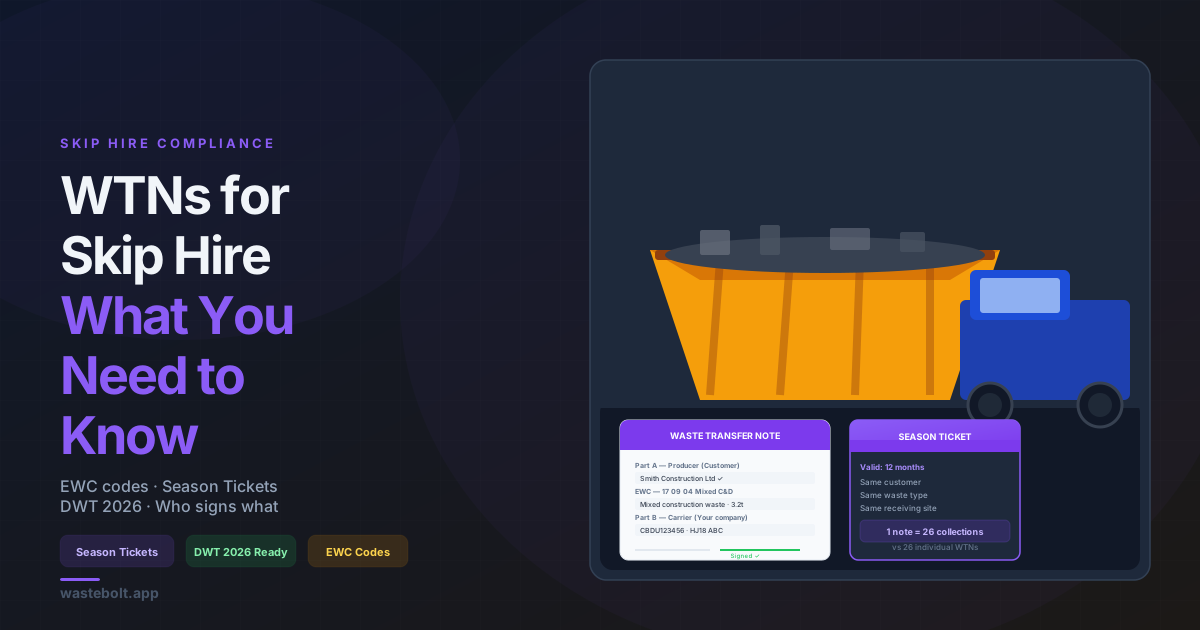
Do Skip Hire Companies Need Waste Transfer Notes?
Yes. Every time a skip is collected from a customer's site and taken to a transfer station, recycler, or landfill, a Waste Transfer Note is required under Section 34 of the Environmental Protection Act 1990.
Skip hire sits at the intersection of three separate Duty of Care obligations — the customer who produced the waste, the skip hire company acting as carrier, and the receiving site. All three must be documented on every WTN.
This guide covers exactly what a skip hire WTN must contain, who signs what, how Season Tickets can dramatically reduce your paperwork, and what you need to do before October 2026.
Who Is Responsible for the WTN in Skip Hire?
This is the most common area of confusion for skip hire operators.
The customer (waste producer) is responsible for Part A of the WTN — their name, address, SIC code, and confirmation that the waste hierarchy has been considered. They sign as the waste holder transferring the waste.
The skip hire company (waste carrier) is responsible for Part B — their company name, address, and waste carrier registration number (CBDU prefix). They sign as the authorised carrier collecting the waste.
The receiving site is responsible for Part C — their facility name, address, and environmental permit number. They sign on receipt.
In practice for skip hire, Part A is often completed by the skip hire company on behalf of the customer at the point of booking or collection — but the customer must still sign to confirm the information is accurate. A WTN signed only by the skip hire company, without the producer's signature, is not fully compliant.
What Goes on a Skip Hire WTN
Part A — Waste producer (your customer)
- Business or individual name
- Full address of the collection site (where the skip was located)
- SIC code — for individual customers this is often left blank or marked as domestic, but for business customers it must be completed
- Status: Producer
- Signature
Part B — Waste carrier (your skip hire company)
- Your company name and registered address
- Your waste carrier registration number (CBDU)
- Vehicle registration of the collecting vehicle
- Signature
Part C — Receiving site
- Transfer station, recycler, or landfill name and address
- Environmental permit number
- Signature on receipt
Part D — Waste description This is where most skip hire WTNs fall short. "Mixed waste" or "skip waste" is not an acceptable description. You need:
- A specific waste description — "mixed construction and demolition waste", "household waste", "green garden waste"
- EWC code — see our EWC codes for skip hire guide for the full reference
- Physical form — solid
- Containment — skip
- Quantity — estimated weight in tonnes if no weighbridge, or actual weight from the receiving site ticket
Part E — Transfer details
- Date of collection
- Legislative country
- Recovery or disposal code — R13 (storage for recovery) for transfer station, R3 (recycling) for direct recycling, D1 for landfill
The EWC Code Problem in Skip Hire
Skip waste is almost never a single waste type. A builders' skip might contain plasterboard, timber, concrete, metal, and plastic wrap — each with a different EWC code.
The practical approach for mixed skips is to classify by the predominant waste type and describe the mix accurately. Where a load is genuinely mixed, EWC 20 03 01 (mixed municipal waste) or 17 09 04 (mixed construction and demolition waste not containing dangerous substances) are commonly used — but only if that accurately describes what is in the skip.
What you cannot do is use a single EWC code to cover hazardous materials that should have their own classification. Asbestos-containing materials (EWC 17 06 01*), waste paint and solvents (EWC 08 01 11*), and fluorescent tubes (EWC 20 01 21*) are hazardous and cannot be mixed into a standard WTN — they require a Hazardous Waste Consignment Note.
This is why driver training matters. A driver who does not know to flag asbestos ceiling tiles at the bottom of a mixed skip is a compliance risk.
Season Tickets for Skip Hire — Cutting WTN Paperwork by 90%
If you collect skips regularly from the same customer — a construction company, an industrial site, a housing development — you do not need a new full WTN for every collection. A Season Ticket covers unlimited collections of the same waste type between the same producer, carrier, and receiving site for up to 12 months.
When a Season Ticket works for skip hire:
- Same customer site for the duration of a project
- Same waste type on every collection (e.g. always mixed C&D waste)
- Same receiving facility for all loads
- Regular collections on a defined schedule
What changes with a Season Ticket:
- One master document signed once by all three parties covers all loads for up to 12 months
- Each individual collection still requires a docket (weighbridge ticket, delivery note, or similar) referencing the Season Ticket number
- The Season Ticket must be kept by all parties for the full retention period
For a skip hire company serving a six-month construction project with weekly collections, that is 26 full WTNs replaced by one Season Ticket plus 26 simple dockets. The paperwork reduction is significant.
See our WTNs vs Season Tickets guide for more detail on when each is appropriate.
Going Digital: What Skip Hire Companies Need
Paper WTNs create specific problems for skip hire operations:
- Drivers completing notes in the cab with biro — illegible handwriting, missing fields, wrong EWC codes
- Carbon copies getting lost between the driver, the office, and the customer
- No real-time visibility of what waste has moved and where
- Filing cabinets of paper that are impossible to search during an EA inspection
A digital WTN app solves all of these. WasteBolt is built specifically for mobile use — drivers can complete a WTN on their phone in under 90 seconds, capture the customer's signature on-screen, and have the note stored automatically in the Compliance Hub where the office can see it in real time.
For skip hire specifically, WasteBolt offers:
- Saved customer pick-lists so regular customers pre-fill in one tap
- Saved waste type pick-lists with EWC codes attached
- Season Ticket creation and management
- Skippy — a quick-capture tool for photo documentation of collections with GPS stamp
- Task management for assigning collections to drivers and tracking completion
- Direct DWT 2026 submission from within the app
October 2026 — What Changes for Skip Hire
The mandatory Digital Waste Tracking (DWT) system becomes live for waste receiving sites from October 2026. This affects skip hire companies in two ways:
Your receiving sites will require digital data. Transfer stations and recyclers that receive your skips will need to record each incoming load on the DWT platform. They will increasingly require WTN data from you in a format that feeds their system — accurate EWC codes, weights, and carrier registration details. Paper WTNs create friction in this process.
Phase 2 (approximately October 2027) will extend to carriers. Skip hire companies acting as waste carriers will be required to submit movement data to the DWT platform directly. Starting digital now means this transition is a configuration change rather than a process overhaul.
WasteBolt is already connected to the EA DWT platform and has completed the Production Approval Test (PAT) process. Skip hire companies using WasteBolt are already DWT-ready.
Practical Checklist for Skip Hire WTN Compliance
- Every skip collection has a WTN or is covered by an active Season Ticket
- Part A includes the customer's business name, collection address, SIC code, and signature
- Part B includes your CBDU registration number and the collecting vehicle registration
- Part C includes the receiving site's environmental permit number
- EWC code accurately describes the predominant waste type
- No hazardous materials included in a standard WTN
- All three parties have signed before or immediately after transfer
- Copies retained for minimum 2 years (3 years in Scotland)
- Carrier registration verified on EA public register
Frequently Asked Questions
Does a skip hire company need a waste carrier licence? Yes. Any business that transports waste as part of its commercial activity needs an upper tier waste carrier registration (CBDU prefix). This must be renewed every three years. See our waste carrier licence guide for full details.
Who signs the WTN — the driver or the skip hire company? The driver signs on behalf of the skip hire company as the waste carrier (Part B). The customer signs as the waste producer (Part A). The receiving site signs on receipt (Part C). All three signatures are required for a fully compliant note.
What if the customer refuses to sign? Waste should not leave the site without a signed producer declaration. In practice, many skip hire operators have customers sign a standing agreement at the point of booking that covers all collections — this is legally acceptable if the agreement is specific about waste type and transfer route.
Can one WTN cover multiple skips collected on the same day? Each skip collection is technically a separate transfer and should have its own WTN. However, if multiple skips from the same customer site are collected in a single run to the same facility on the same day, a single WTN covering all loads with a total quantity is generally accepted — document the number of skips clearly in the waste description field.
What EWC code should I use for a mixed household skip? EWC 20 03 01 (mixed municipal waste) is most commonly used for household skip waste. For predominantly construction waste, EWC 17 09 04 (mixed construction and demolition waste not containing dangerous substances) is more appropriate. Use our EWC code lookup tool to verify.
Last updated: June 2026. Covers England, Wales, Scotland and Northern Ireland. Legislation: Environmental Protection Act 1990 · Waste (England and Wales) Regulations 2011.