The Three-Party Signature Requirement
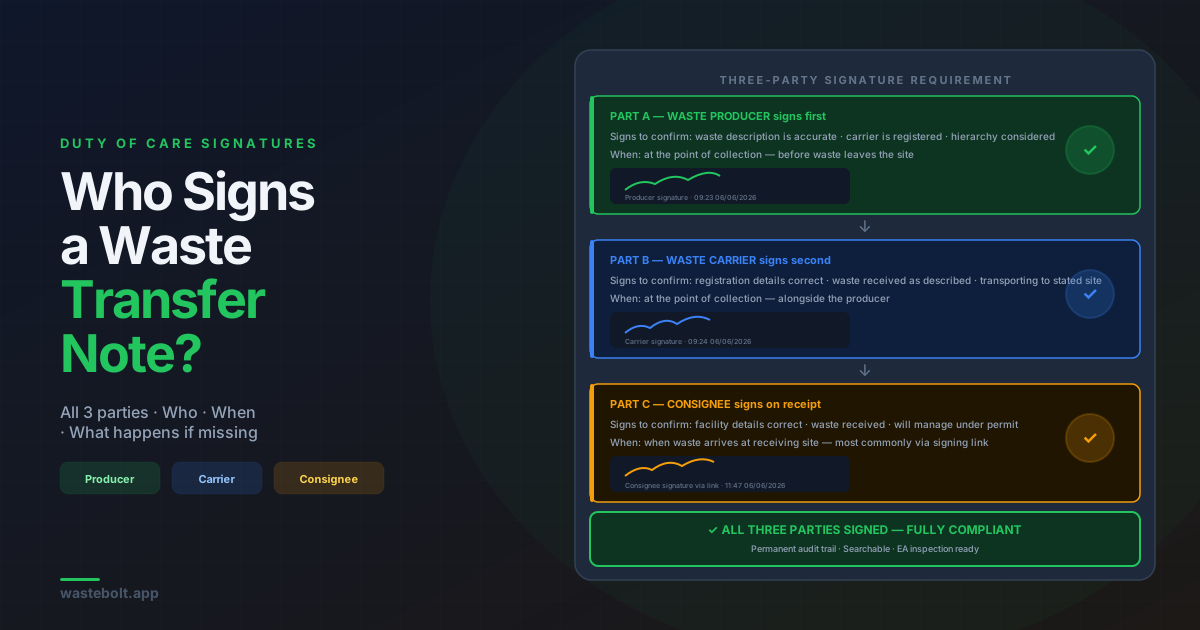
A Waste Transfer Note is not legally complete until it has been signed by all three parties involved in the transfer:
- The waste producer (or holder) — the business or individual transferring the waste
- The waste carrier — the registered carrier transporting the waste
- The consignee (waste receiver) — the facility receiving the waste
Each signature is a separate legal declaration. By signing, each party confirms that the information recorded in their section is accurate and that their Duty of Care obligations have been met. A WTN with one or two signatures but not all three is not fully compliant — it is evidence of a transfer that has not been properly documented by all parties.
Who Signs Each Part
The Producer Signs Part A
The waste producer signs to confirm:
- Their business details are correct
- The waste description and EWC code accurately describe what is being transferred
- The waste hierarchy has been considered (mandatory in Northern Ireland; best practice everywhere)
- The carrier collecting the waste is a registered waste carrier
The producer's signature is typically captured at the point of collection — when the carrier arrives at the site. On a paper WTN, the producer signs before the waste leaves. On a digital WTN, the producer signs on-screen or the carrier captures the signature on their phone or tablet at the gate.
The Carrier Signs Part B
The carrier signs to confirm:
- Their waste carrier registration details are correct and current
- They have received the waste as described
- They will transport it to the facility stated in Part C
The carrier's signature is captured at the point of collection, alongside the producer's. In practice, on many paper-based collections, the driver and the site operative sign at the same time. On a digital system, the driver signs on their device immediately after the producer.
The Consignee Signs Part C
The consignee signs to confirm:
- Their facility details and permit or exemption number are correct
- They have received the waste as described
- The waste will be managed in accordance with their permit
The consignee signs at the point of receipt — when the waste arrives at the receiving facility. This is the signature that is most frequently missing on paper WTNs, because by the time the waste reaches the receiving site the WTN may not have travelled with it, or the receiving site may not have a straightforward way to return a signed copy to the producer.
When Each Party Must Sign
The Duty of Care regulations require that all parties sign and that each retains a copy of the signed note. The timing requirements are:
Producer and carrier: Must sign at or before the point of transfer — before the waste leaves the producer's site. This is the clearest requirement and the easiest to enforce in practice.
Consignee: Must sign on receipt of the waste. In practice, "on receipt" means when the waste arrives and is accepted at the facility. For a transfer station receiving dozens of loads per day, this may mean the site manager signs a batch of notes at the end of the day rather than one by one — this is generally accepted as long as the signature is obtained on the day of receipt.
If the consignee is not present: For unmanned drop-off points or situations where waste is left at a site without a receiving operative present, the consignee must sign as soon as practicable after receiving the waste and must provide a signed copy to the carrier and producer. An unsigned WTN for this type of transfer is a compliance risk.
What Happens If a Signature Is Missing
Missing producer signature: The WTN does not establish that the producer transferred waste to an authorised person. The producer is exposed to a Duty of Care breach even if the carrier is registered and the receiving site is permitted.
Missing carrier signature: The carrier has not confirmed receipt of the waste. If the waste is later found to have been fly-tipped or improperly disposed of, the absence of the carrier's signature makes it harder to establish the chain of custody.
Missing consignee signature: The most common compliance gap. Without the consignee's signature, there is no confirmation that the waste arrived at the permitted facility. The transfer record is incomplete. During an EA audit, an unsigned WTN will be flagged.
The Environment Agency can issue fixed penalty notices and refer cases for prosecution where WTNs are incomplete or unsigned. The absence of a consignee signature is treated as a failure of the Duty of Care chain.
How to Get All Three Signatures Digitally
Digital WTN platforms eliminate the logistical barriers to three-party signing. In WasteBolt:
On-site signatures The producer and carrier sign on-screen using WasteBolt's built-in signature pad. Each signature is captured on a phone or tablet at the point of collection — one device, handed between parties, takes under a minute.
Remote signing links The consignee receives a secure signing link by email or WhatsApp. They open the link on any device — no WasteBolt account needed — see the WTN details, and sign using the on-screen signature pad. The signature is stored in WasteBolt with a timestamp.
Automatic email delivery When a WTN is completed in WasteBolt, the system can automatically email the signed PDF to the consignee's email address stored in the pick-list. Including the signing link in this email means the consignee can sign on receipt the moment the email arrives.
Managing Missing Signatures
Even with a good digital workflow, some WTNs will end up unsigned or partially signed — a consignee who did not receive the email, a driver who forgot to get the producer to sign, a busy receiving site that missed the link.
WasteBolt's Compliance Hub shows the signature status of every note clearly:
- Fully signed — green indicator
- Partially signed — amber indicator showing which parties have signed
- Unsigned — red indicator
You can filter your note list to show only partially signed or unsigned notes. From the note, you can generate a new signing link for the missing party and send it directly from WasteBolt.
For notes that are days or weeks old and still unsigned, the process is the same — open the note, generate a signing link for the missing party, send it. There is no time limit on when a missing signature can be obtained, though obtaining signatures close to the date of transfer is always preferable for audit purposes.
See our complete guide to chasing missing WTN signatures for more on managing unsigned notes in bulk.
Season Tickets — Different Signature Requirements
Season Tickets have different signing requirements from individual WTNs. A Season Ticket is signed once by all three parties at the start of the agreement — this single set of signatures covers all loads transferred under the Season Ticket for up to 12 months.
Individual loads under a Season Ticket do not require a full three-party signature on each docket. A docket referencing the Season Ticket number and recording the date, weight, and vehicle is sufficient for each load. The Season Ticket itself must be signed by all three parties and retained by all parties for the full retention period.
See our Season Tickets guide for more on how Season Tickets differ from individual WTNs.
Frequently Asked Questions
Can the same person sign for multiple parties? No. Each party must be a distinct legal entity and sign independently. A driver cannot sign as both carrier and consignee. A site manager cannot sign as both producer and carrier.
What if the producer is unavailable to sign when the carrier arrives? The carrier should not remove waste from the site without obtaining the producer's signature. If the producer is temporarily unavailable, the carrier should wait. If the producer has authorised someone else to sign on their behalf, that authorisation should be documented. Removing waste without any producer signature creates a Duty of Care breach for both parties.
Does a digital signature need to be a handwritten-style signature? No. Under UK law, a digital signature can be any form of electronic agreement — a typed name, a click-to-confirm, or a handwritten signature captured on a touchscreen. WasteBolt uses a touchscreen signature pad for the clearest audit trail, but the legal requirement is that each party has indicated their agreement to the document.
How long do signed WTNs need to be retained? Minimum 2 years in England, Wales, and Northern Ireland. Minimum 3 years in Scotland. WasteBolt stores all WTNs permanently — there is no action needed to retain them beyond the minimum period.
What if the consignee refuses to sign? If a receiving site refuses to provide a consignee signature, do not transfer the waste. A receiving site that will not sign a WTN may not be properly authorised to receive the waste — check their permit on the EA public register before proceeding. If the receiving site is legitimate but administratively resistant, escalate to their management and document your attempts to obtain the signature.
Last updated: June 2026. Covers England, Wales, Scotland, and Northern Ireland. Legislation: Environmental Protection Act 1990 · Duty of Care Regulations 1991.