The Direct Answer
Not having a Waste Transfer Note when you should have one is a criminal offence under Section 34 of the Environmental Protection Act 1990.
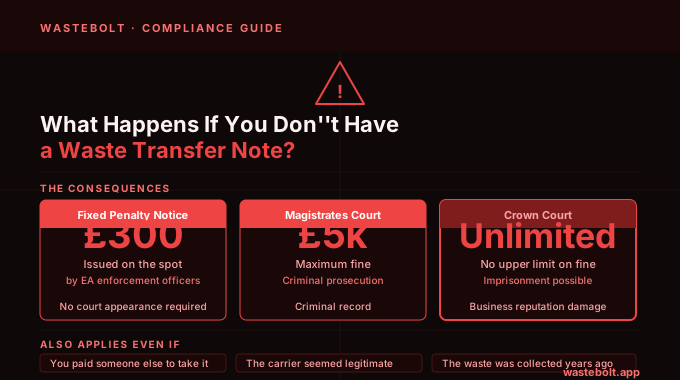
The consequences range from a fixed penalty notice issued on the spot, to prosecution in the Magistrates Court with fines up to £5,000, to prosecution in the Crown Court where there is no upper limit on the fine and imprisonment is possible.
This is not a grey area. The Duty of Care obligation is one of the most clearly enforced aspects of UK waste law, and the Environment Agency, SEPA, Natural Resources Wales, and the NIEA all actively enforce it.
What Exactly is the Legal Obligation?
Section 34 of the Environmental Protection Act 1990 places a legal Duty of Care on everyone in the waste chain — producers, carriers, and receivers — to ensure that waste is managed correctly from the moment it is generated to the point of final disposal or recovery.
Part of that Duty of Care is completing a Waste Transfer Note (WTN) every time non-hazardous commercial or industrial waste changes hands. The WTN documents who produced the waste, who carried it, where it went, what it was, and that everyone involved was authorised to deal with it.
The obligation applies to:
- Every business that produces commercial or industrial waste
- Every registered waste carrier transporting that waste
- Every licensed facility receiving it
There is no minimum quantity threshold. A single skip of construction waste, a single bag of commercial food waste, a single pallet of industrial scrap — all require a WTN.
The Penalties in Detail
Fixed Penalty Notice
The Environment Agency and other regulators have the power to issue fixed penalty notices to businesses and individuals found to be in breach of their Duty of Care obligations. Fixed penalties can be issued on the spot without court proceedings.
The amount varies by regulator and the nature of the breach, but fixed penalties represent the lowest tier of enforcement — a quick administrative sanction for less serious or first-time non-compliance.
Magistrates Court — up to £5,000
More serious cases, or those where fixed penalties have been ignored or challenged, are referred for prosecution in the Magistrates Court. The maximum fine at Magistrates Court level is £5,000 per offence.
A Magistrates Court conviction also produces a criminal record, which can affect business reputation, insurance premiums, and the ability to hold certain environmental permits and licences.
Crown Court — Unlimited Fine
The most serious cases — deliberate non-compliance, repeat offending, or cases linked to fly-tipping or illegal waste disposal — can be referred to the Crown Court. At Crown Court level there is no upper limit on the fine. There is also the possibility of a custodial sentence for the most serious offences.
Crown Court cases are relatively rare for straightforward WTN non-compliance, but they do occur where regulators identify a pattern of deliberate behaviour or where the environmental harm caused is significant.
Enforcement Notices and Licence Revocation
Beyond fines, the Environment Agency can issue enforcement notices requiring specific compliance actions within a set timeframe. For waste carriers and permitted sites, persistent non-compliance can result in revocation of the waste carrier licence or environmental permit — effectively ending the ability to operate legally.
The Misconceptions That Get Businesses Into Trouble
"I paid someone else to take the waste — it is their problem now"
This is the most common and most costly misconception in waste compliance.
The Duty of Care obligation does not end when you hand your waste to a carrier. As the original waste producer, you remain legally responsible for ensuring the waste was transferred to an authorised person, transported by a licensed carrier, and disposed of at a permitted facility.
If the carrier you paid turns out to be unregistered, or if your waste is fly-tipped, you can face prosecution as the producer — even if you had no knowledge of what happened after collection.
A WTN protects you precisely because it records that you checked the carrier's registration, identified the disposal site, and took reasonable steps to ensure proper handling. Without it, you have no evidence that you exercised Duty of Care.
"The carrier looked legitimate so I assumed they were registered"
Assuming is not enough. The Duty of Care requires you to take reasonable steps to verify that your carrier is registered. Checking the Environment Agency public register takes less than two minutes and is the only reliable way to confirm a carrier's registration is current.
A carrier may have had a valid registration at some point that has since expired. A carrier may have been registered under a different company name. A carrier may simply be operating illegally. None of these scenarios protect you if you did not check.
The EA public register for England is at environment.data.gov.uk/public-register/waste-carriers-brokers. SEPA, Natural Resources Wales, and NIEA each maintain equivalent registers.
"It was only a small amount of waste"
There is no quantity threshold below which the WTN obligation does not apply. A single bin bag of commercial waste transferred to an unregistered carrier without a WTN is the same offence in law as a full lorry load.
"The transfer happened years ago — they cannot pursue it now"
The minimum retention period for WTNs is 2 years in England, Wales, and Northern Ireland, and 3 years in Scotland. However, EA investigations and prosecutions can look back further than these periods, particularly where there is evidence of systematic non-compliance or where the transfers are connected to an incident such as fly-tipping that is being investigated.
There is no strict time limit on prosecution for Duty of Care offences in the way that there is for some regulatory breaches.
"I did not know I needed one"
Ignorance of the law is not a defence. The Duty of Care under Section 34 of the Environmental Protection Act 1990 has been in force since 1992. All businesses generating commercial waste are expected to know their obligations.
How the Environment Agency Identifies Non-Compliance
The EA and other regulators use several routes to identify businesses not meeting their WTN obligations:
Roadside vehicle checks. EA enforcement officers can stop waste carrying vehicles and ask to see documentation for the load being carried. A driver unable to produce a WTN for the load on the vehicle is an immediate enforcement trigger.
Site inspections. Permitted sites — transfer stations, recycling facilities, landfills — can be inspected and their records examined. Where incoming loads do not have corresponding WTNs, the EA will investigate both the site and the producer.
Fly-tipping investigations. When fly-tipped waste is found, the EA investigates the origin of the waste. Businesses whose waste has been fly-tipped can face prosecution even where they had no involvement in the fly-tipping itself, if they cannot demonstrate they transferred the waste to a legitimate carrier with a WTN.
Intelligence and tip-offs. The EA receives information from members of the public, local authorities, and other businesses. Competitors, neighbours, and local councils all report suspected non-compliance.
Data matching. As Digital Waste Tracking becomes mandatory from October 2026, the EA will have access to a central database of all waste movements. Gaps or inconsistencies in the data will be far more visible than they are under the current paper-based system.
Hazardous Waste — The Stakes Are Higher
For hazardous waste, the document required is not a standard WTN but a Hazardous Waste Consignment Note under the Hazardous Waste Regulations 2005. The penalties for non-compliance with hazardous waste documentation requirements are the same as for standard WTNs — criminal prosecution, fines, potential imprisonment — but the EA treats hazardous waste breaches with greater seriousness given the potential for environmental harm.
Common hazardous waste streams found in skips and commercial premises that require consignment notes rather than WTNs include asbestos-containing materials, contaminated soil, fluorescent tubes, fridges and freezers, batteries, and solvent-based paints and varnishes.
What to Do if You Realise You Have a Gap in Your WTN Records
If you identify that WTNs are missing for historical transfers, do not ignore it. Take the following steps:
Contact the carrier. They should have their signed copy of every WTN. Request copies of any missing notes — carriers are legally required to keep them for 2 or 3 years depending on nation.
Contact the disposal site. The receiving facility also holds a copy. If the carrier cannot provide documentation, the site may be able to.
Document what you know. If copies genuinely cannot be obtained, create a written record of what you know about the transfer — approximate date, waste type, carrier name, destination — and retain it. This is not a substitute for a WTN but it demonstrates that you attempted to comply and that the transfer was not deliberately concealed.
Go digital going forward. The simplest way to ensure WTN gaps never occur again is to use a digital WTN system where notes are created at the point of transfer and stored automatically. There is no manual filing, no lost paperwork, and no gaps.
The Simple Fix
A Waste Transfer Note takes less than two minutes to complete digitally. The fine for not having one can be thousands of pounds, with a criminal record attached.
Wastebolt's free WTN generator at wastebolt.app/free-wtn-generator produces a legally compliant WTN in under two minutes — no account needed, no subscription.
For businesses producing regular WTNs, the Wastebolt app stores every note automatically, validates EWC codes and carrier registration formats, captures digital signatures at the point of transfer, and keeps your records audit-ready at all times.
Start a free 7-day trial — no credit card required.
Frequently Asked Questions
Can I be prosecuted even if the waste was disposed of correctly? Yes. The obligation is to complete and retain a WTN — the correct disposal of the waste does not override the documentation requirement. If you cannot produce the WTN, you cannot prove compliance regardless of what actually happened to the waste.
What if the carrier did not give me a copy of the WTN to keep? Both parties must sign and retain copies. If the carrier did not provide you with a copy, contact them and request it. Going forward, always ensure you retain your signed copy before the waste leaves your site — not afterwards.
Can the EA inspect my WTN records without warning? Yes. EA enforcement officers can conduct unannounced inspections and request to see waste transfer records. You are expected to be able to produce records promptly — not to need days to locate them.
Is there a difference between not having a WTN and having an incorrect WTN? Both are compliance failures, but they are treated differently. An incorrect WTN — wrong EWC code, missing carrier number, vague waste description — may result in a warning or fixed penalty. No WTN at all demonstrates a more fundamental failure of Duty of Care and is treated more seriously.
Does having a WTN protect me if the waste is later fly-tipped? A properly completed WTN significantly reduces your exposure. It demonstrates you transferred the waste to a named, registered carrier and identified the destination site. However, if the carrier you used was not legitimately registered despite appearing so, you may still face questions. Always verify carrier registrations on the EA public register before transfer.
What about waste produced by sole traders or very small businesses? The obligation is the same regardless of business size. A sole trader generating commercial waste has identical Duty of Care obligations to a large corporation.
Summary
Not having a Waste Transfer Note is a criminal offence. The penalties range from on-the-spot fixed penalties to unlimited fines and potential imprisonment in the Crown Court.
The obligation applies to every commercial waste transfer regardless of quantity, and it does not end when you hand the waste to a carrier. You remain liable as the producer for where that waste goes.
The fix is straightforward. A WTN takes under two minutes to complete digitally, costs nothing, and is your evidence that you took your Duty of Care seriously.
Try the free WTN generator — no signup needed.
Last updated: April 2026. Legislation references: Environmental Protection Act 1990 (Section 34) · Duty of Care Regulations 1991 · Hazardous Waste Regulations 2005.