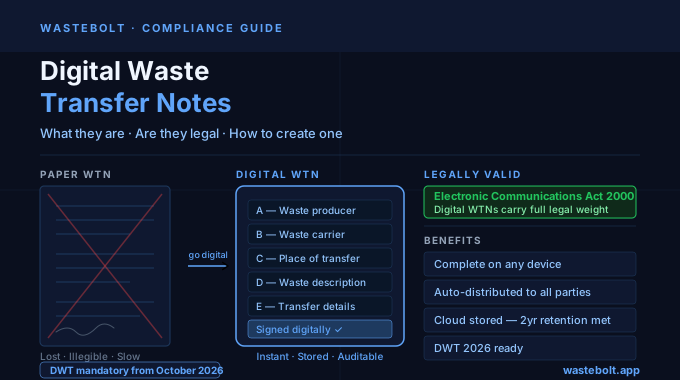
What is a Digital Waste Transfer Note?
A digital waste transfer note is exactly what it sounds like — a Waste Transfer Note (WTN) that is created, signed, and stored electronically rather than on paper. It contains the same legal information as a paper WTN, satisfies the same regulatory requirements, and carries the same legal weight. The only difference is the format.
Every UK business that produces, carries, or receives non-hazardous commercial waste must complete a WTN each time waste changes hands. The legal obligation comes from Section 34 of the Environmental Protection Act 1990 and the accompanying Duty of Care Regulations 1991. Nothing in that legislation specifies that the note must be on paper — and that is the key point that makes digital WTNs fully valid.
Are Digital Waste Transfer Notes Legally Valid?
Yes. Digital WTNs are fully legal under UK law.
The Electronic Communications Act 2000 established that electronic documents and electronic signatures carry the same legal standing as their paper equivalents. HMRC, the courts, and the Environment Agency all recognise electronic records as legally binding where they contain the required information and have been properly signed.
The Environment Agency has confirmed that digital waste transfer notes are acceptable provided they:
- Contain all the information required by the Duty of Care Regulations (producer details, carrier details, receiver details, waste description, EWC code, transfer date, signatures from all parties)
- Can be produced during an inspection or audit
- Are retained for the minimum legal period (2 years in England, Wales, and Northern Ireland — 3 years in Scotland)
Digital signatures are specifically recognised under the Electronic Signatures Regulations 2002. A signature captured on a touchscreen, a typed confirmation, or a click-to-sign mechanism all satisfy the signature requirement on a WTN.
Digital WTN vs Paper WTN — What Actually Changes?
The legal content of the note is identical. What changes is everything around it.
Paper WTN
- Completed by hand or typed and printed
- Requires physical signatures from producer, carrier, and receiver — often at different times and locations
- Must be physically distributed to all three parties (post, hand delivery, or scan and email)
- Stored in filing systems, folders, or boxes
- Retrieving a specific note during an audit means searching through physical records
- Lost, damaged, or illegible notes create compliance gaps
- No validation — wrong EWC codes, missing fields, and incorrect carrier numbers go unnoticed until an audit
Digital WTN
- Completed on any device — phone, tablet, or desktop
- Signatures captured digitally on-screen at point of transfer or sent via secure link
- All parties receive a PDF copy automatically by email
- Stored securely in the cloud — searchable by date, customer, waste type, or EWC code
- Retrievable in seconds during an EA inspection
- Validation built in — EWC codes checked, carrier registration numbers formatted correctly, required fields enforced before the note can be completed
- Creates an automatic audit trail with timestamps on every action
The practical difference for a waste carrier doing 20 collections a week is significant. Paper means 20 sets of paperwork to chase signatures on, distribute, and file. Digital means 20 notes created on a phone, signed at the gate, and stored automatically.
Who Needs a Digital Waste Transfer Note?
The same businesses that need a paper WTN need a digital one — the format does not change the obligation.
Any UK business that produces, carries, or receives non-hazardous controlled waste must complete a WTN for every transfer. This includes:
- Skip hire companies — every collection requires a WTN between the skip hirer and the disposal site
- Waste carriers — every load collected requires a WTN from the producer
- Construction and demolition companies — every removal of C&D waste from site
- Manufacturers and industrial sites — all commercial waste leaving the premises
- Retailers, offices and hospitality businesses — commercial waste collections
- Farms — agricultural waste transfers to licensed carriers
- Anaerobic digestion and biogas plants — all input waste streams
There is no size threshold. A sole trader generating a single skip of construction waste has the same obligation as a large national waste contractor.
Household waste collected by a local authority is exempt. All other commercial and industrial waste transfers require a WTN.
What Information Does a Digital WTN Need to Include?
The required content is set by the Duty of Care Regulations 1991 and is the same whether the note is paper or digital. A legally compliant WTN must include:
Section A — Waste Producer / Holder The business generating the waste. Name, full address, SIC code (Standard Industrial Classification), and any relevant permit or exemption number.
Section B — Waste Carrier The business physically transporting the waste. Name, address, and their Waste Carrier Registration number — a CBDU or CBDL prefixed number issued by the Environment Agency. This must be verified as current before transfer.
Section C — Place of Transfer / Receiver The destination site. Name, address, and their environmental permit number, waste management licence, or registered exemption number. Only sites with appropriate waste management authorisation can legally accept waste.
Section D — Waste Description A specific description of the waste, the six-digit EWC (European Waste Catalogue) code, physical form (solid, liquid, gas, sludge), containment method, and the relevant recovery or disposal code (R1–R13 for recovery, D1–D15 for disposal).
Section E — Transfer Details Date of transfer, weight or estimated quantity, and any additional information. A weighbridge docket reference can be included where a formal weight has been obtained.
Signatures from all three parties — producer, carrier, and receiver.
Digital WTNs and the Waste Hierarchy
Every WTN requires confirmation that the waste hierarchy has been applied. The waste hierarchy ranks waste treatment options from most to least preferable:
- Prevention
- Reuse
- Recycling
- Other recovery (including energy recovery)
- Disposal (landfill as last resort)
The producer must confirm they have selected the best available treatment option for the waste being transferred. This is reflected in the recovery or disposal code selected on the WTN — an R code (recycling or recovery) is always preferable to a D code (disposal).
Season Tickets — The Alternative to Individual WTNs
Where the same waste type is transferred between the same producer and the same carrier on a regular basis, a Duty of Care Season Ticket can be used instead of a new WTN for every collection.
A Season Ticket covers an ongoing series of transfers for up to 12 months. It is signed once by all three parties and covers all collections within that period for that waste type. Each individual collection still requires a docket (recording the specific date, vehicle, and weight), but the WTN paperwork is completed once rather than repeatedly.
Season Tickets are particularly useful for:
- Skip hire companies with regular commercial customers
- Manufacturers with weekly or daily waste collections
- Construction sites with ongoing contracts for waste removal
How Long Must Digital WTNs Be Kept?
The retention requirement is the same as for paper notes:
- England, Wales, and Northern Ireland: minimum 2 years
- Scotland: minimum 3 years
Digital storage makes this requirement trivially easy to meet. Cloud-stored notes cost nothing to keep and can be retained indefinitely without taking up physical space. Retrieving a specific note from 18 months ago for an EA inspection takes seconds rather than minutes of searching through filing cabinets.
Best practice is to keep digital WTNs indefinitely. Storage costs nothing and an extended audit trail demonstrates consistent compliance over time.
What Happens if You Cannot Produce a WTN?
The Environment Agency can inspect waste carriers, producers, and disposal sites and request to see WTNs during or after a transfer. Failing to produce a compliant WTN — or any WTN at all — is a criminal offence under Section 34 of the Environmental Protection Act 1990.
Penalties include:
- Fixed penalty notices from the relevant environmental regulator
- Prosecution in the Magistrates Court — fines up to £5,000
- Prosecution in the Crown Court — unlimited fines
The burden of proof is on you as the waste producer or carrier to demonstrate that the waste was transferred legally. If you cannot produce documentation, the assumption is non-compliance.
Critically, you remain liable for the waste even after you have paid someone else to collect it. If your carrier turns out to be unregistered, or if your waste is illegally disposed of, you face liability as the original producer. A WTN protects you by creating a documented chain of custody showing you took reasonable steps to ensure the waste was handled correctly.
Digital Waste Tracking 2026 — What Changes?
From October 2026, the UK government is making Digital Waste Tracking (DWT) mandatory. This is a significant change that goes beyond digital WTNs.
Under DWT, waste movements will need to be recorded on a central digital platform operated by DEFRA and the Environment Agency. The platform will track waste from producer to disposal site in real time, replacing the current system of individual WTN documentation for most waste types.
Businesses that are already using digital WTNs are significantly better positioned for this transition. The data required by the DWT platform is largely the same data that appears on a WTN — producer details, carrier details, EWC codes, waste description, weights, and destination. Having this data in a digital system means it can be submitted directly to the DWT platform without re-entry.
Businesses still on paper will face a harder transition — converting historical paper records and changing established manual workflows under a mandatory deadline is significantly more disruptive than upgrading from one digital system to another.
The practical advice is straightforward: go digital now, before October 2026 forces the issue.
How to Create a Digital Waste Transfer Note
There are two routes to creating a digital WTN:
Free WTN generator (no account required) Wastebolt's free WTN generator at wastebolt.app/free-wtn-generator lets you complete all five sections of a legally compliant WTN, download a formatted PDF, and receive a copy by email. No signup, no subscription. Suitable for businesses that produce WTNs occasionally.
Wastebolt app (full digital compliance) For businesses producing regular WTNs — skip hire companies, waste carriers, manufacturers — the Wastebolt app provides:
- Saved pick-lists for customers, carriers, waste types, and vehicles — so repeat notes take under a minute
- Digital signature capture at point of transfer — no chasing paper
- Automatic PDF generation and distribution to all parties
- Cloud storage with full search and audit trail
- Season ticket management for regular collections
- Hazardous Waste Consignment Notes for notifiable waste streams
- Driver task management — assign collections, capture dockets, mark complete
- Direct connection to the EA's Digital Waste Tracking platform ahead of the October 2026 mandate
Start a free 7-day trial — no credit card required.
Frequently Asked Questions
Is a digital WTN legally the same as a paper WTN? Yes. Digital WTNs are fully legally valid under the Electronic Communications Act 2000. They must contain the same information as a paper WTN and be signed by all three parties. The format does not affect their legal standing.
Can I use a digital signature on a WTN? Yes. Electronic signatures are legally recognised under the Electronic Signatures Regulations 2002. A signature captured on a touchscreen, a typed acceptance, or a click-to-sign confirmation all satisfy the signature requirement.
Does the carrier need to sign the digital WTN on site? The WTN should be signed by all parties as close to the point of transfer as possible. Digital systems allow the carrier to sign on a phone or tablet at the point of collection, or to sign via a link sent to their email. The key requirement is that all three parties sign before or at the time of transfer.
Can I email a PDF WTN to my carrier and customer? Yes. Emailing a signed PDF to all parties is a recognised method of distributing WTN copies. All parties must retain their copy for the required period.
Do I still need WTNs after October 2026? The DWT system will replace WTNs for most waste movements. However, the transition is expected to be phased, and the core information requirements will remain the same. Digital systems built around WTN data will connect directly to the DWT platform — the transition for digital users will be straightforward.
What is the difference between a WTN and a Hazardous Waste Consignment Note? A WTN covers non-hazardous controlled waste. Hazardous waste — identified by an asterisk (*) in the EWC catalogue — requires a Hazardous Waste Consignment Note under the Hazardous Waste Regulations 2005. The consignment note contains additional fields including HP codes (hazardous property classifications) and, where relevant, a POPs (Persistent Organic Pollutants) declaration.
What if I make a mistake on a digital WTN? If you notice an error before all parties have signed, correct it before completing the note. If the error is discovered after signing, the best practice is to create a corrected note and retain both — the original and the corrected version — with a note explaining the amendment. Never delete a signed WTN, even if it contains an error.
Summary
Digital waste transfer notes are legally valid, practically superior to paper in almost every respect, and are the only sensible preparation for the mandatory Digital Waste Tracking system coming in October 2026.
The legal content requirement is identical to paper WTNs — producer details, carrier details, receiver details, waste description, EWC code, transfer date, and signatures from all parties. The difference is that digital notes are faster to complete, automatically distributed, securely stored, and instantly retrievable.
For UK businesses still on paper WTNs, the transition to digital is straightforward and the benefits are immediate. For businesses already using digital WTNs, the priority is ensuring the system they use will connect to the DWT platform ahead of October 2026.
Try the free WTN generator — no account needed. Or start a free trial to see the full Wastebolt compliance platform.
Last updated: April 2026. Legislation references: Environmental Protection Act 1990 · Duty of Care Regulations 1991 · Electronic Communications Act 2000 · Electronic Signatures Regulations 2002 · Hazardous Waste Regulations 2005.