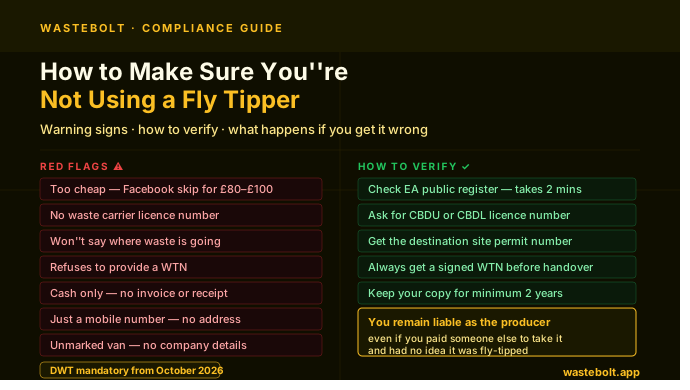
The Problem Nobody Talks About
Every day in the UK, businesses hand their waste to carriers who are not registered, not insured, and have no intention of disposing of it legally. Sometimes those businesses know — they are looking for the cheapest option and not asking questions. More often, they have no idea.
The law does not distinguish between the two.
As the original waste producer, you have a legal Duty of Care under Section 34 of the Environmental Protection Act 1990. That duty does not end when the waste leaves your site. If your carrier dumps your waste illegally, you can face prosecution, a demand to fund the clean-up, and a criminal record — even if you genuinely believed you were using a legitimate operator.
This guide covers how to spot the warning signs of an unregistered carrier or fly tipper before you hand your waste over, and exactly how to verify that a carrier is legitimate.
Why Fly Tippers Target Businesses
Fly tipping is not just a problem created by individuals dumping a mattress in a country lane. A significant volume of fly-tipped waste comes from businesses — and a significant proportion of that involves carriers who have deliberately positioned themselves to undercut legitimate operators.
The economics are straightforward. A legitimate waste carrier pays:
- Environment Agency registration fees
- Vehicle insurance for waste carrying
- Gate fees at licensed disposal and recycling facilities
- Staff costs including proper training
An unregistered carrier pays none of these. They can offer a skip or a clearance at a fraction of the legitimate market rate, collect the waste, and dump it — in a lay-by, on a country lane, in someone else's skip, or at an unlicensed site. The margin is the avoided disposal cost.
Businesses who accept these prices are funding the problem, even where they do not know it.
The Warning Signs
The price is too good to be true
This is the single most reliable warning sign. If a waste carrier is offering a price significantly below what legitimate operators in your area charge, the first question to ask is how they are making that work.
Legitimate skip hire in the UK typically costs £150–£400 or more depending on size, location, and waste type. A Facebook post offering a skip for £80 or a house clearance for £100 is almost certainly not going to result in your waste reaching a licensed facility.
The gap between their price and the market rate is roughly equal to the disposal cost they are avoiding. That cost ends up somewhere — and that somewhere is usually a field, a forestry track, or an industrial estate.
They cannot provide a waste carrier licence number
Every legitimate waste carrier operating in the UK must be registered with the relevant environmental regulator and hold a valid waste carrier licence. In England, that licence is issued by the Environment Agency and carries a reference number beginning with CBDU or CBDL.
Ask any carrier for their waste carrier registration number before agreeing to use them. A legitimate operator will provide it without hesitation — it is a basic part of their credentials and they display it on their vehicles and documentation.
If a carrier hesitates, claims not to have one, says it is in the office, or tells you it is not required, do not use them.
They will not tell you where the waste is going
A Duty of Care Waste Transfer Note requires the name, address, and permit number of the site receiving the waste. Completing a WTN therefore requires the carrier to identify the destination.
An unregistered carrier operating without a WTN has no obligation to tell you where the waste is going — and often actively avoids the question because there is no licensed site waiting for it.
If a carrier is unable or unwilling to name the disposal or recycling site and provide its permit number, that is a clear sign they either do not know where it is going or they know and do not want to tell you.
They refuse to complete a Waste Transfer Note
Every non-hazardous commercial waste transfer in the UK legally requires a Waste Transfer Note. If you ask a carrier to complete a WTN and they refuse, tell you it is not required, or say "we don't do paperwork", do not hand them your waste.
Some unregistered carriers will go further and actively discourage documentation — "it just slows things down", "we've always done it this way", "you don't need that for this type of waste". These are not reassurances. They are flags.
A legitimate carrier will expect to complete a WTN. It protects them as much as it protects you.
Cash only, no invoice
Legitimate waste carriers are businesses. They issue invoices, accept bank transfers or card payments, and keep financial records. A carrier who only accepts cash and offers no invoice or receipt is operating in a way that avoids a paper trail — because a paper trail is a liability trail.
Cash-only transactions also make it harder for you to demonstrate what you paid for, who you paid, and what the payment was for — all of which becomes relevant if your waste is subsequently found fly-tipped.
Just a mobile number — no company address or website
Search the name or number of any carrier you are considering using. A legitimate waste business will have a verifiable company address, often a website, and will appear in Companies House records or on the EA register.
A carrier operating only through a mobile number, a Facebook profile, or a WhatsApp contact with no verifiable business address is extremely difficult to hold accountable if something goes wrong — and you will have very little to show an EA inspector about who you engaged.
An unmarked vehicle with no company details
Legitimate waste carriers are required to have their registered company name and address on their vehicles in many circumstances. More broadly, a professional waste business brands its vehicles because they are a moving advertisement.
An unmarked van or lorry collecting commercial waste is not necessarily illegitimate, but combined with any of the other warning signs above, it is a significant red flag. Always note the vehicle registration plate of any carrier collecting your waste — it is one of the few pieces of evidence you have if the load is subsequently found dumped.
Pressure to hand over the waste quickly without documentation
Unregistered carriers do not want to spend time on site. The longer they are there, the more opportunity for questions, documentation requests, or witnesses. If a carrier is hurrying you, dismissing questions about paperwork, or just loading up and moving before you have had a chance to see any documentation, slow them down.
You have the right to ask for credentials before your waste leaves your site. Exercise it.
How to Verify a Waste Carrier is Legitimate
Step 1 — Ask for the waste carrier registration number
Ask directly before agreeing anything. The number should begin with CBDU (upper tier — most commercial carriers) or CBDL (lower tier — limited exemption carriers). Write it down.
Step 2 — Check the EA public register
Go to the Environment Agency's public register and search the registration number:
environment.data.gov.uk/public-register/waste-carriers-brokers
Confirm that:
- The registration is active (not expired or revoked)
- The company name on the register matches the name on the vehicle or invoice
- The registration covers the type of waste being collected
For Scotland use the SEPA register, for Wales use Natural Resources Wales, and for Northern Ireland use the NIEA register. Each operates an equivalent public database.
This check takes under two minutes and is the single most reliable verification step available to you.
Step 3 — Ask for the destination site details
Ask the carrier where the waste is going — the name of the disposal or recycling facility and their environmental permit number. You need this information to complete a WTN, so if they cannot provide it you cannot complete the documentation regardless.
If they name a site, you can verify that site holds a current environmental permit on the relevant regulator's public register.
Step 4 — Complete a Waste Transfer Note before the waste leaves
Do not hand over waste until a WTN has been completed and signed by both parties. The WTN records the carrier's registration number, the destination site, the waste description and EWC code, and the date of transfer. Your signed copy is your evidence of compliance.
A legitimate carrier will sign a WTN without hesitation. Resistance to completing one is itself a red flag.
Step 5 — Keep your copy
Retain your signed WTN for a minimum of two years (three years in Scotland). Store it in a way that makes it retrievable — digitally is far more reliable than paper.
What Happens if You Get It Wrong
You may be liable for the clean-up costs
Under the Environmental Protection Act 1990, the original waste producer can be required to contribute to or fund the clean-up of illegally dumped waste. Local authorities and the EA have the power to pursue clean-up costs against producers where it can be shown the waste was not transferred with proper Duty of Care.
Fly-tipping clean-up costs range from hundreds of pounds for a small roadside dump to tens of thousands for large-scale or hazardous waste incidents.
You may face prosecution
The Duty of Care offence is committed not just by the person who dumps the waste but by the producer who transferred it without taking reasonable steps to ensure it was handled correctly. Prosecution can result in fines up to £5,000 in the Magistrates Court or unlimited fines in the Crown Court.
Your carrier licence may be at risk
If you operate as a waste carrier yourself and are found to have used an unregistered sub-contractor or to have transferred waste without WTN documentation, your own carrier registration may be subject to review or revocation.
"I didn't know" is not a complete defence
The Duty of Care requires you to take reasonable steps. If you did not check the EA register, did not ask for a licence number, and did not complete a WTN, you have not taken reasonable steps — regardless of whether you subjectively believed the carrier was legitimate.
The EA will ask what you did to verify the carrier. "They seemed professional" and "they were cheapest on Facebook" are not answers that demonstrate reasonable steps.
The Scale of the Problem
Fly tipping costs the UK hundreds of millions of pounds in clean-up costs every year. The Environment Agency recorded over 1 million fly-tipping incidents in England alone in recent years. The majority of large-scale incidents — the ones that end up on farmland, in nature reserves, or in rivers — involve commercial quantities of waste that originated from businesses.
Every business that uses an unregistered carrier without a WTN is a link in that chain, whether knowingly or not.
A Note on Facebook and Social Media
Facebook Marketplace, local community groups, and Gumtree are increasingly used by unregistered carriers to find customers. The combination of low prices, informal communication, and no verifiable business identity makes these channels particularly risky.
This does not mean every carrier advertising on social media is a fly tipper — many legitimate small operators use Facebook to find customers. But the concentration of unregistered operators in these channels is significantly higher than in traditional directories or trade listings.
The verification steps above apply equally to carriers found on social media. If anything, apply them more rigorously where the contact comes through an informal channel.
How Wastebolt Helps
Wastebolt builds carrier registration number validation directly into the WTN completion process. When you create a WTN for a carrier, the carrier registration field validates the format (CBDU/CBDL prefix) before the note can be completed — making it harder to accidentally overlook.
Your saved carrier pick-list stores verified carrier details so repeat transfers are fast without cutting corners. Every WTN is stored automatically in your Compliance Hub — searchable, retrievable, and audit-ready.
The free WTN generator at wastebolt.app/free-wtn-generator lets you create a legally compliant note for any transfer without a subscription.
Start a free 7-day trial — no credit card required.
Quick Reference — Before Any Waste Leaves Your Site
- Ask for the carrier's waste carrier registration number (CBDU or CBDL)
- Check it on the EA public register — confirm active and matching
- Ask for the destination site name and permit number
- Complete a Waste Transfer Note signed by both parties
- Keep your signed copy for a minimum of 2 years (3 in Scotland)
- Note the vehicle registration plate of the collecting vehicle
If a carrier cannot or will not satisfy any of these steps — do not hand over your waste.
Frequently Asked Questions
What if the carrier says they are exempt from registration? Some very low-risk waste activities operate under registered exemptions rather than full carrier licences. However, exemptions are limited and specific — they do not cover general commercial waste carrying. If a carrier claims an exemption, ask for the exemption reference number and verify it on the appropriate regulator's register. If they cannot provide one, treat them as unregistered.
Can I use a broker instead of dealing directly with a carrier? Yes. Waste brokers arrange the collection and disposal of waste without physically transporting it themselves. Brokers must also be registered with the EA (registration numbers typically begin with CBDB). Using a registered broker does not remove your obligation to complete a WTN — the broker should facilitate this as part of the service.
What if I am a skip hire company and my customer uses a fly tipper to put waste in my skip? As the skip operator, you are responsible for what is in your skip when you collect it. If you collect a skip containing waste that is subsequently found to have included hazardous or prohibited materials dumped by a third party, you need to be able to demonstrate what steps you took. A clear terms and conditions with customers, a visible prohibited items list on skips, and a documented process for checking loads before collection all contribute to demonstrating reasonable steps.
Is there a reward for reporting fly tippers? The EA and local authorities both accept reports of fly tipping and suspected illegal waste carriers. Reporting does not result in financial reward but it contributes to enforcement activity that reduces the problem. The EA's report a waste crime page allows anonymous reporting.
Does the same apply in Northern Ireland, Scotland, and Wales? Yes. The Duty of Care obligation exists across all UK nations under equivalent legislation. The relevant regulators differ — SEPA in Scotland, Natural Resources Wales in Wales, NIEA in Northern Ireland — but the verification steps and documentation requirements are the same.
Last updated: April 2026. Legislation references: Environmental Protection Act 1990 (Section 34) · Duty of Care Regulations 1991 · Environmental Protection (Duty of Care) Regulations 1991.