The Direct Answer
Yes — house clearance companies must complete a Waste Transfer Note (WTN) for every load of waste they collect. They must also hold a registered waste carrier licence from the Environment Agency. Failing either requirement is a criminal offence under Section 34 of the Environmental Protection Act 1990.
This applies whether you are a sole trader doing occasional clearances or a large clearance company handling dozens of jobs a week.
Why House Clearance Companies Have a Duty of Care
When a house clearance company collects waste from a property, it becomes the waste carrier for that load. The homeowner or estate is the waste producer. Both parties have responsibilities under the duty of care, but the carrier — your company — takes on primary responsibility for how the waste is transported and disposed of.
The duty of care exists to prevent fly-tipping and ensure waste reaches a legitimate, permitted facility. The Environment Agency can trace waste back to the original clearance company if it ends up illegally dumped, and prosecute accordingly.
Waste Carrier Registration
Before you can legally collect waste from a property for payment, you must be registered as a waste carrier with the Environment Agency (England), SEPA (Scotland), or Natural Resources Wales (NRW).
Upper Tier registration is required for commercial house clearance companies — those collecting, carrying, buying, or selling waste as a business activity. Upper Tier registration costs £154 and is renewed every 3 years.
Lower Tier registration applies only to businesses that carry their own waste (e.g., a builder taking their own rubble to a tip). It does not cover carrying waste produced by other people — so it does not apply to house clearance work.
Carrying waste without the correct registration is a criminal offence. The EA actively checks carrier registrations and unregistered operators regularly face prosecution and fines.
Check your registration: Search the EA's public waste carrier register at gov.uk to confirm your registration is current before every job.
What Must Be on a House Clearance WTN?
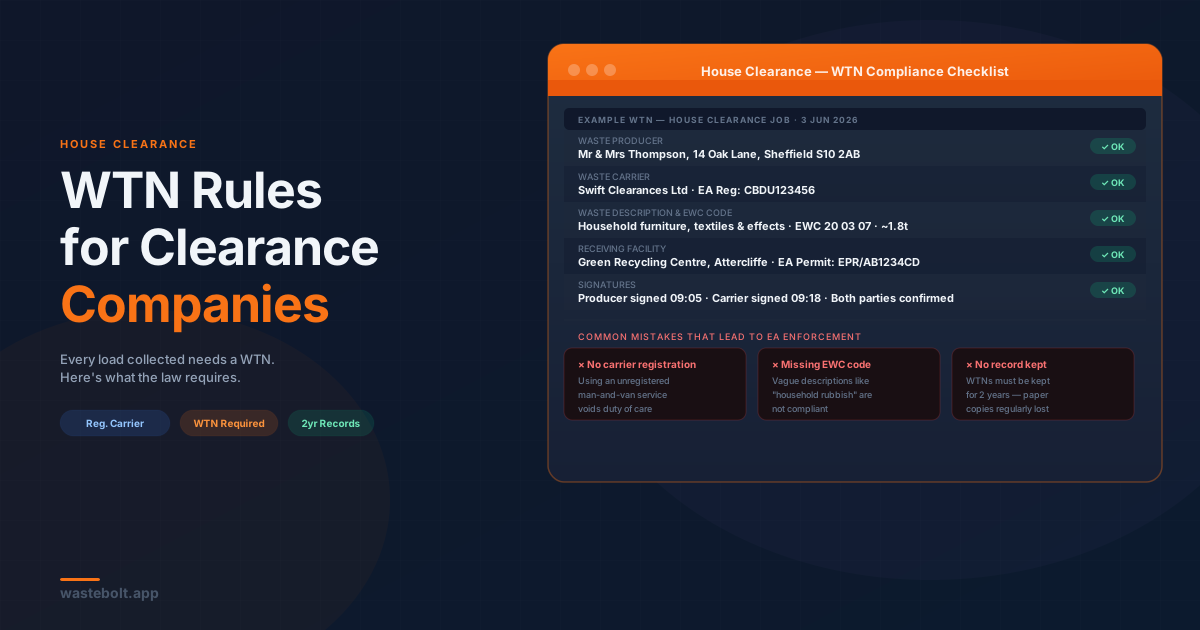
Every WTN you complete must include the following information:
About the waste producer:
- Name and address of the property being cleared
- Name of the person transferring the waste (homeowner, executor, estate agent)
About the waste carrier (your company):
- Company name and address
- EA waste carrier registration number
- Vehicle registration (recommended)
About the waste:
- A description of the waste — what it is, how it is contained
- The EWC (European Waste Classification) code
- Approximate quantity or weight
About the receiving facility:
- Name and address of the site receiving the waste
- Environmental permit or registered exemption reference for that site
Signatures:
- Both the producer and the carrier must sign and date the WTN before the waste is collected
Which EWC Codes Apply to House Clearance?
The most common EWC codes used in house clearance are:
| EWC Code | Waste Type |
|---|---|
| 20 03 07 | Bulky waste (furniture, mattresses, large items) |
| 20 03 01 | Mixed municipal waste (general household waste) |
| 20 01 36 | Discarded electrical and electronic equipment (WEEE) |
| 20 01 11 | Textiles and clothing |
| 20 01 01 | Paper and cardboard |
| 20 01 02 | Glass |
| 20 01 40 | Metals |
| 17 01 01 | Concrete (from outbuildings, garages) |
| 17 02 01 | Wood (timber, fencing, furniture in some cases) |
If you mix different waste types in one load, use the code that best describes the predominant or most hazardous element. If you're in doubt, 20 03 01 (mixed municipal waste) is often used for general clearance loads.
Hazardous waste requires a separate note. Items such as asbestos, certain paints, fluorescent tubes, and tyres may be hazardous and require a Hazardous Waste Consignment Note (HWCN) rather than a standard WTN. If in doubt, check the EA's hazardous waste guidance.
Where Can the Waste Go?
You must take clearance waste only to a facility that is authorised to receive it. This includes:
- Licensed waste transfer stations
- Household Waste Recycling Centres that accept trade waste (check first — many do not)
- Permitted composting or recycling facilities
- Registered waste brokers who will arrange onward disposal
You cannot take house clearance waste to a standard household tip unless the site accepts trade waste and you have agreed this with them. Doing so without authorisation is illegal and constitutes fly-tipping at the facility level.
It is your responsibility to check that the receiving facility holds the correct environmental permit for the waste type you are delivering. This information is on the EA's public register.
Record-Keeping Requirements
You must keep a copy of every WTN for a minimum of 2 years from the date of the transfer. This applies even if your business is small or you only do occasional clearances.
The Environment Agency can inspect your records at any time. If you cannot produce WTNs for your waste movements, you face prosecution for the record-keeping failure independently of any other offence.
Common record-keeping mistakes to avoid:
- Keeping WTNs only on paper and losing them when a filing system is reorganised
- Not keeping a copy for your own records (both parties must have a copy)
- Using a generic job sheet instead of a compliant WTN
Common Enforcement Scenarios
Fly-tipping prosecution. EA investigators find a fly-tipped load and trace it back to a clearance company through identifying items, partial address labels, or CCTV. The clearance company cannot produce a WTN showing a legitimate disposal route. Result: prosecution under the duty of care.
Unregistered carrier check. An EA officer stops a clearance van on the road and asks for the driver's waste carrier registration. The company is unregistered. The officer issues a Fixed Penalty Notice and may refer for prosecution.
Customer complaint. A customer's neighbour reports clearance waste being fly-tipped locally. An investigation traces the company and reveals no WTNs were completed. The clearance company faces prosecution even though the customer had already paid them.
How WasteBolt Helps House Clearance Companies
WasteBolt was designed for businesses that handle waste on the move. For house clearance companies specifically:
- Create a WTN on your phone in under 60 seconds at the job
- The customer signs digitally on your phone screen — no paper needed
- Your EA carrier registration number is saved once and appears on every WTN automatically
- All records stored in the cloud — 2-year retention automatic
- If a signature is missed, WasteBolt flags it and sends an automatic reminder
- Export all WTNs to CSV or PDF for any EA inspection
The end result: every clearance job has a complete, signed, stored WTN — and you can prove it to any inspector in seconds.
Frequently Asked Questions
Does the homeowner need to sign? Yes. The waste producer (the homeowner, executor, or estate) must sign the WTN. In practice this is usually the person present at the property when you collect. If no one is available, you should obtain a signature before or after collection — not skip it entirely.
What if I'm clearing a property for an estate agent or solicitor? The estate agent or solicitor acting on behalf of the estate becomes the waste producer for WTN purposes. They should sign as the producer party.
Do I need a WTN if I'm keeping items to sell? If you're removing items to resell (furniture, antiques), those are not waste — they're goods. No WTN is needed for items you're rescuing for resale. However, anything that genuinely is waste still needs a WTN.
What about WEEE items like TVs and fridges? White goods (fridges, washing machines) and TVs are subject to WEEE regulations. They should be taken to a registered WEEE collection facility and the appropriate EWC code used on the WTN (20 01 36). Disposing of WEEE in general waste is prohibited.
Can I use a season ticket for repeat customers? Yes. If you collect from the same property management company or estate agent regularly and the waste type is consistent, a season ticket (annual WTN) can replace individual notes. Both parties sign once per year rather than per collection.