The Short Answer
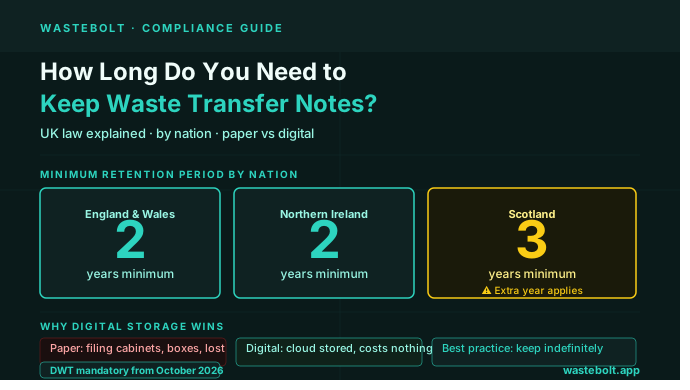
- England, Wales, and Northern Ireland: minimum 2 years
- Scotland: minimum 3 years
Both the waste producer and the waste carrier must keep their signed copy for the full retention period. The receiving site must also retain their copy.
That is the legal minimum. Best practice — and the approach any waste business serious about compliance should take — is to keep waste transfer notes indefinitely. Digital storage costs nothing and makes indefinite retention effortless.
Where Does the Retention Requirement Come From?
The requirement to keep Waste Transfer Notes comes from the Environmental Protection Act 1990 (Section 34) and the Duty of Care Regulations 1991. These establish the legal obligation to complete a WTN for every non-hazardous waste transfer and to retain signed copies for the minimum period.
The specific retention periods by nation are set in the regulations applying to each jurisdiction:
- England and Wales: Waste (England and Wales) Regulations 2011 — 2 years
- Northern Ireland: Controlled Waste Regulations (Northern Ireland) — 2 years
- Scotland: Waste Management Licensing (Scotland) Regulations — 3 years
The Scottish requirement for an additional year is a specific regulatory difference that catches businesses operating across the border. If you collect waste in both England and Scotland, the safest approach is to keep all records for 3 years as a universal minimum.
Who Needs to Keep a Copy?
All three parties involved in a waste transfer must retain a signed copy:
The waste producer — the business whose premises the waste originated from. Even if you paid a carrier to collect and a disposal site to receive, you remain legally responsible for keeping your copy.
The waste carrier — the business physically transporting the waste. Every load they carry requires a WTN and they must keep their copy for the full retention period regardless of how many loads they do.
The waste receiver — the disposal site, recycling facility, or transfer station accepting the waste. They must also retain copies, though in practice this is generally handled by the facility's own compliance systems.
The most common compliance gap is at the producer end — a business hands its waste to a carrier, receives a copy of the WTN at the time of collection, and then loses it, fails to file it properly, or simply does not keep it long enough.
What Happens if You Cannot Produce a WTN During an Audit?
The Environment Agency, SEPA (Scotland), Natural Resources Wales, and the NIEA (Northern Ireland) all have the power to inspect waste records and request WTNs during or after a transfer. Failure to produce a WTN when requested is a criminal offence.
Penalties for failing to maintain adequate waste transfer records include:
- Fixed penalty notices
- Prosecution in the Magistrates Court with fines up to £5,000
- Prosecution in the Crown Court with unlimited fines
The burden of proof is on you. If the EA asks to see documentation for waste transfers from 18 months ago and you cannot produce it, the assumption is non-compliance — even if the transfers were carried out correctly at the time.
It is also worth understanding that WTN obligations do not end when the waste leaves your site. As the original waste producer, you retain liability for where that waste ends up. If your carrier turns out to be unregistered, or if your waste is fly-tipped, you face potential liability as the producer. A complete set of retained WTNs is your evidence that you exercised proper Duty of Care.
Hazardous Waste — Different Rules
The 2 and 3 year retention periods above apply to standard non-hazardous Waste Transfer Notes.
Hazardous waste is covered by a different document — the Hazardous Waste Consignment Note — under the Hazardous Waste Regulations 2005. The retention requirement for hazardous waste consignment notes is 3 years across all UK nations, including England and Wales.
If your business handles any hazardous waste streams — asbestos, contaminated soils, fluorescent tubes, fridges, batteries, solvent-based paints — make sure your records system applies the 3 year retention period to those records regardless of where in the UK the transfer occurred.
Paper Records vs Digital Records — The Practical Reality
Paper
Keeping paper WTNs for 2 or 3 years sounds straightforward until you consider the volume. A skip hire company doing 30 collections a week generates over 1,500 WTNs a year. A waste carrier with multiple drivers could be producing hundreds of notes every month.
Paper records require:
- Physical filing systems — folders, boxes, filing cabinets
- A consistent naming and dating system so records can be found quickly
- Protection from water, fire, and accidental disposal
- Space — two years of WTNs for a busy waste business takes up significant storage
- Manual retrieval during an audit — finding a specific note from 14 months ago in a box of paper is not fast
The most common reason businesses fail EA audits is not that the transfers were non-compliant — it is that the records cannot be produced quickly or at all.
Digital
Digital waste transfer notes stored in the cloud solve every one of these problems:
- No physical space required — cloud storage is effectively unlimited and costs nothing at the scale of WTN records
- Instant retrieval — search by date, customer, carrier, waste type, or EWC code in seconds
- No degradation — digital records do not get wet, fade, or get accidentally thrown away
- Automatic backup — cloud systems replicate data across multiple locations
- Audit ready — produce any record instantly during an EA inspection
- Indefinite retention at no cost — there is no reason not to keep digital records forever
The practical difference during an EA audit is significant. An inspector requests WTNs for a specific customer from six months ago. With paper, that means going through filing boxes. With digital, it is a 10 second search.
Best Practice — Keep Records Indefinitely
The legal minimum is 2 or 3 years depending on your nation. The practical recommendation is to keep waste transfer notes indefinitely.
Here is why:
EA investigations can look back further than the retention period. While the legal minimum defines when you must have records, investigations into fly-tipping or illegal disposal can examine historical transfer patterns going back years. Having records beyond the minimum demonstrates consistent compliance and provides evidence in your defence.
Disputes about waste transfers can arise long after the transfer. A customer dispute, an insurance claim, or a contractual query about what waste was transferred when can arise months or years after the event. Having the WTN solves it instantly.
Digital storage costs nothing. The only reason to delete old WTNs is if storage costs money — and for digital records, it effectively does not. There is no rational reason to delete compliant waste records.
It demonstrates compliance culture. A business that can produce 5 years of complete, organised waste transfer records during an audit sends a clear signal to the EA inspector about how seriously it takes compliance.
Digital Waste Tracking 2026
From October 2026, Digital Waste Tracking (DWT) becomes mandatory across the UK. Waste movements will be recorded on a central DEFRA/EA platform rather than through individual WTN documentation.
DWT does not eliminate the concept of retention — digital records of waste movements will still need to be accessible and accurate. But it does mean that the central platform will hold a copy of every recorded waste movement, which adds an additional layer of record-keeping beyond what individual businesses maintain themselves.
Businesses using digital WTN systems now will transition to DWT significantly more smoothly than those still on paper. The data fields are largely the same — producer, carrier, receiver, EWC code, waste description, weight, date — and a digital system can push that data directly to the DWT platform without re-entry.
Find out more about DWT 2026 and how Wastebolt connects to the EA platform.
How Wastebolt Handles Retention
Every WTN created in Wastebolt is stored automatically in your Compliance Hub — searchable by date, customer, carrier, EWC code, or waste type. There is no manual filing, no boxes, no retrieval problem.
Records are retained in the cloud for as long as your account is active. For businesses that want to ensure records are available beyond their subscription, WTNs can be exported as PDFs at any time and stored independently.
The free WTN generator at wastebolt.app/free-wtn-generator emails you a PDF copy of every note you create — download it and you have your copy, stored wherever you choose.
For full cloud-based retention with instant retrieval, the Wastebolt app stores every note permanently against your account. Start a free 7-day trial — no credit card required.
Frequently Asked Questions
Do I need to keep WTNs if I only produce waste occasionally? Yes. The retention obligation applies to every WTN regardless of how frequently you produce waste. A business that has a skip collected twice a year still needs to keep both WTNs for 2 years (3 in Scotland).
Does the carrier need to keep a copy as well as the producer? Yes. Both the producer and the carrier must retain signed copies for the full retention period. The receiver must also keep a copy. All three parties have an independent obligation.
What if I lost a WTN before the retention period was up? Contact the carrier or the disposal site — they should have their copy. If no copy can be produced, document what you know about the transfer (date, carrier, waste type, approximate quantity) and keep that record instead. It is not as good as a WTN but it demonstrates you attempted to comply.
Do Season Tickets have the same retention requirement? Yes. A Duty of Care Season Ticket must be retained for 2 years (3 in Scotland) after the end of the period it covers — not from when it was created. If a Season Ticket runs for 12 months and ends in December 2025, you must keep it until at least December 2027 in England.
Does the 2 year period start from the date of the transfer or the date the note was signed? From the date of the transfer — the date the waste actually moved. In most cases this is the same as the signing date, but where notes are signed retrospectively the transfer date is the relevant starting point.
Are there different rules for hazardous waste consignment notes? Yes — hazardous waste consignment notes must be kept for 3 years across all UK nations, including England and Wales where the standard WTN retention period is only 2 years.
Can I store WTNs electronically and delete the paper originals? Yes, provided the electronic copy is a faithful reproduction of the original signed document. A scanned PDF of a paper WTN, or a digital WTN with captured electronic signatures, both satisfy the retention requirement. You do not need to keep paper originals once you have a reliable electronic copy.
Summary
| Nation | Minimum Retention | Document Type |
|---|---|---|
| England | 2 years | WTN (non-hazardous) |
| Wales | 2 years | WTN (non-hazardous) |
| Northern Ireland | 2 years | WTN (non-hazardous) |
| Scotland | 3 years | WTN (non-hazardous) |
| All UK nations | 3 years | Hazardous Waste Consignment Note |
The legal minimum is the floor, not the target. Digital storage costs nothing — keep your waste transfer records indefinitely and you will never have a retention compliance problem.
Last updated: April 2026. Legislation references: Environmental Protection Act 1990 · Duty of Care Regulations 1991 · Waste (England and Wales) Regulations 2011 · Hazardous Waste Regulations 2005.