How to Write a Waste Transfer Note: Complete Step-by-Step Guide
A practical guide to completing all five sections of a UK Waste Transfer Note correctly — with a real worked example, the 10 most common mistakes, and what changes under DWT 2026.
Prefer to skip straight to creating a WTN?
Our free generator auto-fills all required fields and produces a legally compliant note in under 2 minutes.
What is a Waste Transfer Note?
A Waste Transfer Note (WTN) is a legal document required under Section 34 of the Environmental Protection Act 1990 whenever non-hazardous commercial or industrial waste changes hands in the UK. It creates a documented chain of custody — proving that waste was passed to an authorised person and recording what happened to it.
Both the waste producer and the receiving party (carrier or disposal site) must complete and sign the note. Copies must be retained for a minimum of two years (three in Scotland).
Who needs to complete a Waste Transfer Note?
Any UK business that produces, carries, or receives non-hazardous controlled waste must complete a WTN. There are no size thresholds — a sole trader generating a single skip of construction waste has the same obligation as a large manufacturer.
In practice this covers farms, construction sites, offices, retailers, manufacturers, hospitality businesses, and healthcare facilities. If commercial waste leaves your premises with a registered carrier, a WTN is required.
How to write a Waste Transfer Note — 7 steps
A WTN is divided into five sections (A–E). The steps below follow the order you would naturally complete them:
Gather the information you need
Before you start, collect:
- Your business name, full address, and SIC code
- A specific description of the waste and its EWC code
- The carrier's registration number — verify it against the EA public register
- The disposal site's environmental permit number
- Waste quantity and how it is contained (bagged, loose, skipped, etc.)
Section A — Producer details
Record the waste producer's information:
- Name: your business or trading name
- Address: full address including postcode
- SIC code: standard industrial classification (e.g. 38.11 for waste collection)
- Status: mark as Producer, Carrier, Broker, or Dealer as appropriate
- Permit or licence number: if your business holds one
Section B — Carrier details
Document the licensed waste carrier:
- Name: carrier company name
- Address: carrier's registered business address
- Carrier registration number: CBDU or CBDL prefix — must be current
- Vehicle registration: the collecting vehicle
Section C — Place of transfer
Identify where the waste is going:
- Facility name and address
- Environmental permit number: or waste management licence number
- Exemption number: if the site operates under a registered exemption
Section D — Waste description
Describe the waste accurately. Vague descriptions are the most common cause of rejected notes:
- Description: specific (e.g. "Mixed office paper and cardboard", not "office waste")
- EWC code: 6-digit code — use our EWC lookup tool if unsure
- Waste type: commercial, industrial, or construction
- Physical form: solid, liquid, sludge, powder, or gas
- Quantity: weight (kg or tonnes) or volume (m³)
- Containment: how the waste is packaged or held
Section E — Transfer details
Record the specifics of the transfer:
- Transfer date: the date the waste left your site
- Legislative country: England & Wales, Scotland, or Northern Ireland
- Recovery or disposal code: R codes for recycling/recovery; D codes for disposal
- Waste hierarchy: mandatory confirmation in Northern Ireland
Signatures and distribution
All three parties — producer, carrier, and receiver — must sign and date the note. Each party must retain a signed copy for a minimum of two years (three years in Scotland).
Digital signatures are fully legally binding under UK law and remove the logistical difficulty of obtaining wet signatures on paper at the point of collection.
Real completed example
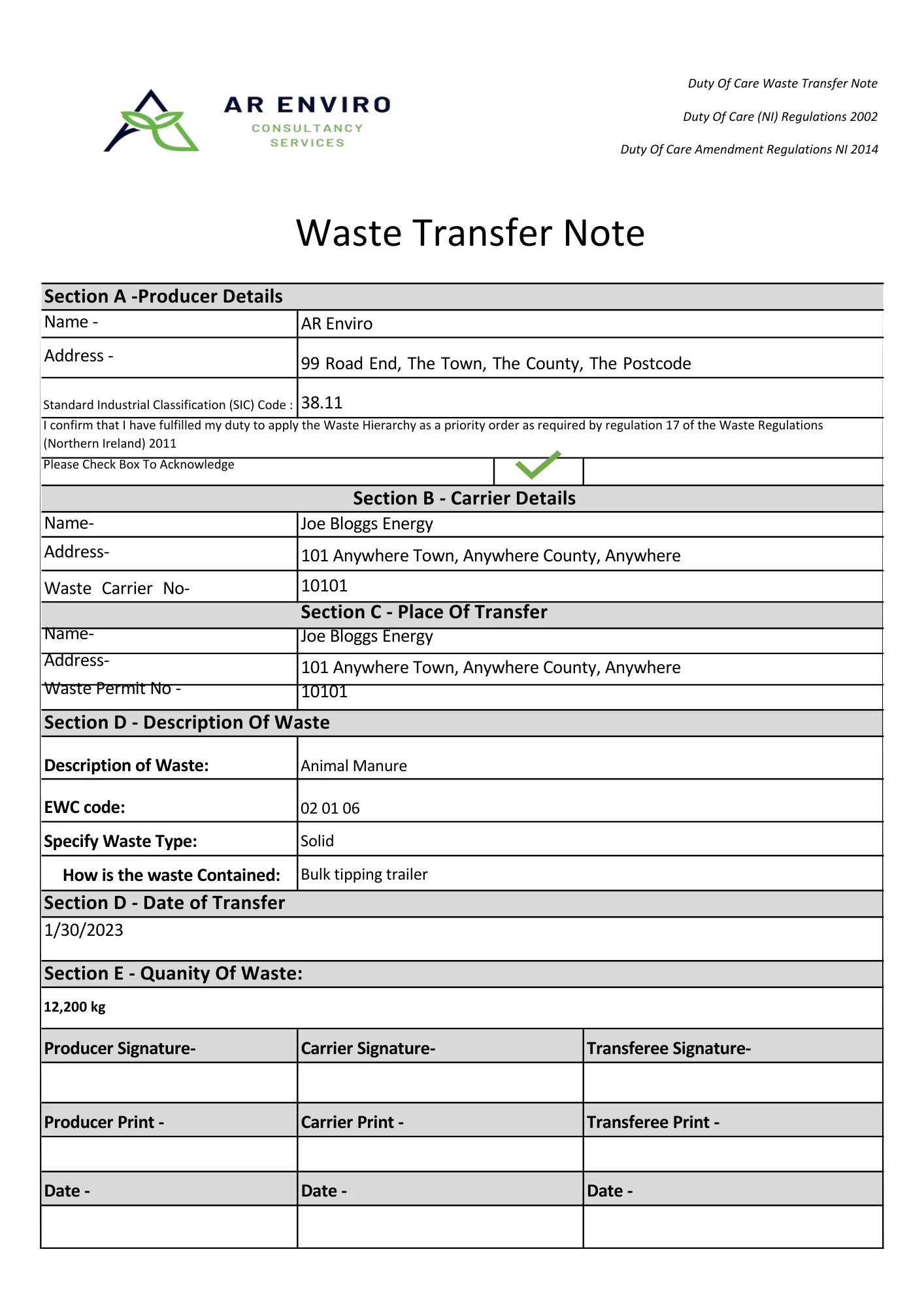
Below is a WTN completed by AR Enviro Consultancy Services — WasteBolt's parent company — for a transfer of animal manure under Northern Ireland regulations. It shows all five sections completed correctly.
10 common WTN mistakes to avoid
These are the errors that most commonly result in rejected notes, failed audits, or Environment Agency fines:
- 1.
Wrong EWC code
Using an incorrect European Waste Catalogue code is the single most common mistake. Always use the EWC lookup tool or verify against the official list before completing the note.
- 2.
Not verifying the carrier's licence
Assuming a carrier is registered without checking the EA register. An expired or invalid registration makes both parties non-compliant.
- 3.
Vague waste description
Writing "waste" or "mixed waste" instead of a specific description. The Environment Agency expects enough detail to identify the waste type without ambiguity.
- 4.
Missing signatures
Waste leaving site without all three parties having signed. A WTN without all signatures is not legally valid.
- 5.
Not retaining a copy
Failing to keep your signed copy, or losing it before the two-year retention period is up.
- 6.
Wrong legislative country
Selecting England & Wales when operating in Scotland or Northern Ireland. Each nation has different retention periods and additional requirements.
- 7.
Using a disposal code when a recovery code applies
Marking waste for landfill (D1) when it is actually being recycled (R3). This misrepresents the waste hierarchy and can constitute a compliance failure.
- 8.
Incorrect physical form
Marking liquid waste as solid, or sludge as powder. Physical form affects handling and transport requirements and must be accurate.
- 9.
Missing SIC code
Leaving the Standard Industrial Classification code blank. Look up your SIC code at Companies House if you are unsure.
- 10.
Paper notes getting lost or damaged
Paper WTNs fade, get damaged, or disappear during office moves. An inability to produce a WTN during an audit carries the same penalty as never having completed one.
Season Tickets for regular waste collections
If your business has regular collections of the same waste type from the same producer to the same carrier and disposal site, a Season Ticket replaces the need for a new WTN on every collection. One master document covers all transfers for up to 12 months, supported by individual dockets for each load.
Use a Season Ticket when:
- Same waste type every collection
- Same carrier each time
- Same disposal site
- Collections happen on a regular basis
Do not use a Season Ticket when:
- One-off or occasional transfers
- Waste type varies between collections
- Carrier or disposal site changes
- Hazardous waste (use consignment notes)

Digital vs paper WTNs
Digital WTNs carry the same legal weight as paper notes and are accepted by the Environment Agency. From October 2026, mandatory Digital Waste Tracking (DWT) will require waste receiving sites to submit data digitally — making a digital workflow the sensible preparation now.
| Feature | Paper WTN | Digital WTN |
|---|---|---|
| Legal compliance | Yes | Yes |
| Typical completion time | 10–15 minutes | 2 minutes (auto-fill) |
| Error rate | High (manual) | Low (validation) |
| Risk of loss | High | None (cloud backup) |
| Retrieval speed | Minutes to hours | Instant search |
| DWT 2026 ready | No | Yes |
Legal requirements by UK region
WTN regulations are broadly similar across the UK but differ in a few important details:
England & Wales
Scotland
Northern Ireland
Frequently asked questions
What is a Waste Transfer Note?
A WTN is a legal document required whenever non-hazardous commercial or industrial waste changes hands in the UK. It creates a documented chain of custody and must be kept for at least two years by all parties.
Who needs to complete a Waste Transfer Note?
Any UK business that produces, carries, or receives non-hazardous controlled waste. There is no size threshold — it applies equally to small businesses and large manufacturers.
What information must be on a Waste Transfer Note?
The note must include the waste description, quantity, EWC code, producer details and SIC code, carrier name and registration number, disposal site details and permit number, transfer date, and signatures from all parties.
How long must I keep Waste Transfer Notes?
Minimum two years in England, Wales, and Northern Ireland. Three years in Scotland. Best practice is to keep them indefinitely using digital storage, which costs nothing and makes audit retrieval instant.
Are digital Waste Transfer Notes legally valid?
Yes. Digital WTNs are fully legal under UK law. Digital signatures are binding under the Electronic Communications Act 2000. They are also the sensible preparation for mandatory Digital Waste Tracking from October 2026.
What is the difference between a WTN and a Season Ticket?
A Season Ticket covers multiple transfers of the same waste type between the same parties over up to 12 months. Individual WTNs are required for each one-off transfer. Season Tickets still require a docket for each individual collection.
What happens if I cannot produce a Waste Transfer Note during an audit?
The Environment Agency can issue a fixed penalty or refer the case for prosecution. Fines can reach £5,000 in Magistrates Court, with no upper limit in Crown Court. The burden of proof is on you to demonstrate compliance.
Helpful resources
Continue reading
WasteBolt
Create legally compliant WTNs in under 2 minutes
WasteBolt auto-fills all required fields, validates EWC codes, collects digital signatures, and stores every note securely in the cloud. Already used by hundreds of UK waste businesses.
No credit card required · Cancel any time · DWT 2026 ready
Stay ahead of UK waste compliance
Get practical guides, regulatory updates, and the occasional WasteBolt discount — straight to your inbox. No spam, unsubscribe any time.
By subscribing you agree to receive marketing emails from WasteBolt. See our Privacy Policy. Unsubscribe any time.